

Learn how to get a home loan in Hyderabad in 2026. Check eligibility, documents, interest rates, PMAY subsidy, approval process and expert tips.
Hyderabad’s booming real estate market is exciting for homebuyers – but it also means competition for financing. In Q1 2026 the city saw 9,126 new housing launches as demand remains strong. Overall property prices rose ~3% year-on-year (and even 12% in hotspots like Narsingi‑Kokapet).
Whether you’re a techie eyeing a flat in Kokapet or a young couple dreaming of a home near Hitech City, understanding the local market, loan requirements and smart strategies can make all the difference. This guide covers everything from market trends and eligibility to interest rates, documentation, government schemes and expert tips – all wrapped in an engaging, story-driven style. By the end, you’ll know how to navigate Hyderabad’s home loan landscape and follow in the footsteps of homebuyers who succeeded.
Imagine Rahul, a software engineer in Gachibowli, and his wife Priya, a school teacher in Kondapur. They’ve saved for years and are ready to buy a 2BHK apartment near Madhapur. Like many Hyderabadis, they want a home loan to bridge the gap. Their journey highlights key lessons: from checking credit scores and co-applying, to choosing the right bank and leveraging subsidies. Let’s dive in step by step, sprinkling in their story and practical tips along the way.
Hyderabad Housing Market: Trends and Opportunities

Hyderabad’s housing market has been buoyant. According to Cushman & Wakefield, new project launches exploded in early 2026 – over 9,100 units in just Q1. West Hyderabad (Financial District, Kokapet, Nanakramguda) saw 65% of these launches, and the North zone (e.g. Balanagar) contributed 19%. Developers balanced projects across core (36%), peripheral (36%) and suburban (29%) areas, catering to mid-range (42%) as well as luxury homebuyers. Crucially, capital values are rising – on average 3% year-on-year citywide, and a whopping 12% in fast-growing suburbs.
All this means Hyderabad stands out as a key real estate destination. The IT boom (Madhapur/Gachibowli) and improved infrastructure (metros, ORR, flyovers) keep demand high. Rents are rising too, so property here is not just a home – it’s an investment. However, strong demand pushes prices higher, so timing and financing are crucial. As a buyer, expect to do your homework on location, builder reputation and price trends before jumping in. Research recent sales and RERA approvals: being well-informed will give you confidence when negotiating with banks.
Eligibility and Documentation: What You Need

Before you apply, ensure you meet basic eligibility and have all required documents ready. Lenders typically check your age, income, credit history and employment. In India, borrowers usually must be 18–65 years old, and many banks prefer borrowers in the 21–60 range. Salaried applicants often need at least 2–3 years at their job, and self-employed entrepreneurs typically need 3 years of business vintage. A good credit score (CIBIL/CRIF) is key: experts say a score above ~750 makes you eligible for the lowest interest rates. In fact, borrowers with clean credit profiles (750+) generally get the most attractive offers. Priya and Rahul made sure their score was solid before applying, since even a 0.25% difference in rate can save lakhs over a long loan.
Most banks require:
- Proof of identity – e.g. PAN card, Aadhaar card or passport.
- Proof of address – e.g. utility bill, driving licence or rent agreement.
- Income proofs – for salaried individuals: latest 3–6 months’ salary slips and Form 16 or last 2 years’ ITR; for self-employed: last 3 years’ audited ITRs and balance sheets.
- Bank statements – usually 6–12 months of statements or passbook to show salary credits and expenses.
- Property documents – the sale agreement or allotment letter from the builder/society, approved building plan, land title papers (or earlier deeds), NOC from the society or ULC authority, etc. (often, banks give a “sanction letter” subject to final property verification).
To fast-track approval, keep your KYC (identity/address) and financial paperwork in order. Priya’s tip: keep scanned copies of all documents handy. And don’t forget passport-size photos and a signed loan application form (banks usually provide one). If applying with a co-applicant (recommended – see below), include their documents too. Having this checklist checked off can shorten approval time from weeks to days.
Interest Rates & Choosing a Lender
Once you’re eligible and have paperwork ready, shop around for the best interest rate and terms. In 2026, floating home loan rates in India ranged roughly from 7.1% up to 10% depending on the lender and borrower profile. For example, the State Bank of India offered loans from about 7.25% onward (currently ~7.25–8.95% depending on your credit/loan size), while Bank of India advertised down to 7.10% for top clients. Among private lenders, HDFC Bank’s lowest rate was ~7.20% onwards, and large HFCs like LIC Housing Finance started around 7.15%.
Key takeaway: Rates can vary even within one bank (for different loan amounts or customer profiles). Always ask for the spread over the lender’s base rate. The Mint reports reveal that factors like your CIBIL score or being a long-term salaried employee can shave 0.1–0.3% off the benchmark interest. (Priya’s story: improving her score by paying off a small credit card balance saved her 0.25%.)
Remember, while a low quoted rate is attractive, you should compare the effective interest rate after fees and insurance. Look at processing fees (usually 0.25–0.5% of loan amount) and any hidden costs. Big banks like SBI or PNB sometimes waive the processing fee for loans under ₹8 lakh under special schemes (see PMAY scheme below), which effectively lowers your cost. Also ask if the rate is fixed or floating. In India, almost all home loans are floating-rate (linked to repo/MCLR), but some banks offer an initial fixed-rate honeymoon period (1–2 years) before switching to floating. Decide what suits your comfort: fixed early EMI vs potential benefit if rates fall.
Finally, consider service and convenience, not just rate. NBFCs and HFCs (LIC HFL, Bajaj Housing, PNB Housing Finance, etc.) often have quicker processing and more flexible underwriting. For instance, Bajaj Housing Finance advertised loans from 7.25% p.a., and LIC Housing from 7.15%. Smaller lenders may entertain weaker credit profiles, but check their credibility carefully. Feel free to negotiate or request a “balance transfer” later if a better rate emerges. Rahul plans to switch to a lower rate in 2 years if possible.
Loan-to-Value and Down Payment

Banks won’t finance 100% of your home’s cost – you need to invest your own money upfront. The Reserve Bank caps Loan-to-Value (LTV) ratios at about 80% for most homes above ₹20 lakh, and up to 90% for low-cost affordable housing. In practical terms, if your flat costs ₹50 lakh, the bank may lend up to ₹40 lakh (80%), and you must arrange ₹10 lakh (20%) as down payment. On the other hand, for a smaller, affordable project (under ₹30 lakh), lenders might stretch to 90% financing, meaning only a 10% down payment.
Always plan for at least a 20–25% down payment, plus extra for registration fees (~5–7%), stamp duty and minor renovations. Priya recalls Rahul emptying almost 30% of their savings to meet the down-payment requirement, which was nerve-wracking. Don’t put yourself in a cash crunch: consider borrowing judiciously from fixed deposits or family if needed, but avoid high-interest personal loans for the down payment (they can backfire). In general, a larger down payment reduces your loan principal and EMI, saving you interest in the long run. If you have gold or investments, check if the bank allows “loan against gold” briefly, but only as a very short-term measure.
Government Schemes and Subsidies
Before finalising anything, see if you qualify for Pradhan Mantri Awas Yojana (PMAY–CLSS) subsidies. PMAY-Urban 2.0 (launched Sep 2024) offers interest-rate subsidies to home buyers in the Economically Weaker (EWS), Lower Income (LIG) and Middle-Income groups (MIG). For eligible families (no existing pucca house), this can translate into a one-time subsidy of up to ₹1.8 lakh on your home loan interest. In other words, the government effectively reduces the rate for you on the first ₹25 lakh of loan (for MIG-I) or ₹9 lakh (for EWS/LIG) under the scheme. The scheme conditions require wife (or female co-borrower) as owner in many cases.
Rahul and Priya applied for PMAY under Rahul’s salary account. Getting that approval took extra paperwork (proof of income below ₹9 lakh/yr), but they got a subsidy note which will be reflected in the bank’s schedule. If you qualify, this can cut years off your loan or save lakhs in interest. Besides PMAY, watch for any state or city housing programs (e.g. Telangana’s affordable housing initiatives, though these often target the economically weaker sections).
Step-by-Step Home Loan Application
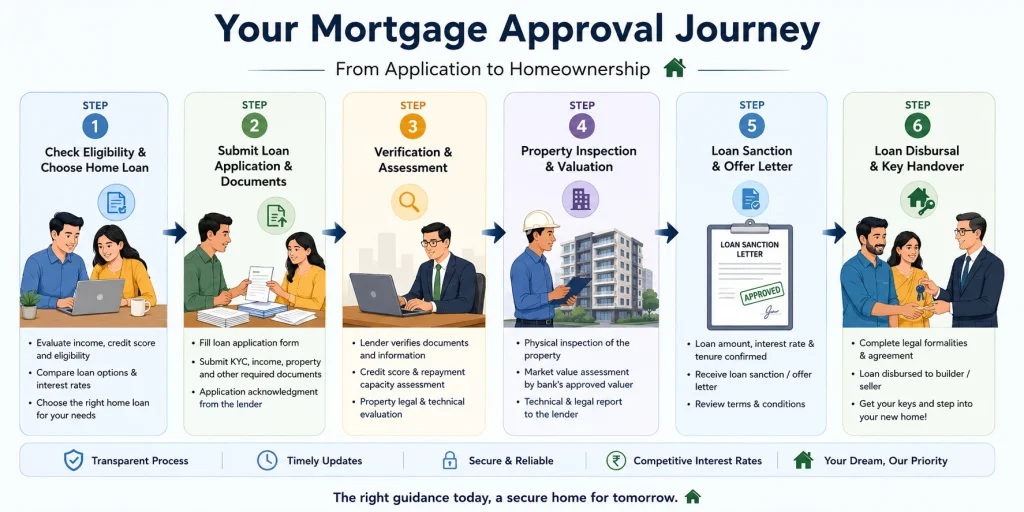
Now let’s walk through the steps of actually applying:
- Check your Credit and Eligibility. Use online tools from banks (SBI, HDFC, Axis, etc.) or portals like Paisabazaar to calculate your likely loan eligibility based on income, age and existing liabilities. Verify your CIBIL score and clear any small outstanding dues. A clean credit profile boosts approval chances.
- Compare Loan Offers. Use official bank sites and aggregators. Look at interest ranges (see table from Mint/clear sources above), but also total cost (EMI calculators include fees). Consider lenders known for quick processing or extra perks (e.g. HDFC’s renewal benefit, ICICI’s zero cost foreclosure after 3 years, SBI’s large branch network). Rahul checked both PSU (SBI/PNB) and private (HDFC, Axis) and even HFCs (LIC HFL) to find his best fit.
- Pre-approval (Optional). Some banks offer a pre-sanction letter after a quick check of your profile (CIBIL check and rough income verification). This is handy when negotiating with sellers, as it shows you’re serious and eligible up to X amount.
- Submit Application with Documents. Fill out the loan application carefully. Include both primary applicant’s and co-applicant’s details (if any). Attach photocopies of all KYC and financial docs. It’s wise to approach the lender branch or relationship manager personally to ensure everything is in order. Given the volume of documentation, having organized files or an online submission portal (some banks offer one) will save headaches.
- Property Valuation & Verification. The bank will arrange a legal and technical check on the property: they verify the title, construction status, and market value (often via an approved valuer). They’ll ask for original documents like the sale deed and may do a site visit. This step can take a few weeks. Stay in touch and provide any extra paperwork (like tax receipts or builder approvals) as needed.
- Loan Sanction Letter. Once cleared, you’ll get a sanction letter detailing the loan amount, interest rate, EMI, tenure, fees and terms. Read it carefully. If you spot anything amiss, discuss it now (e.g. processing fee waivers, slight rate adjustments). Priya double-checked the interest rate float clause before signing.
- Signing and Disbursement. Sign the loan agreement (usually at the bank branch or a notary). Then the bank disburses funds: for a new flat, they typically pay the builder per construction stage; for a resale, they may pay the seller directly. You’ll start EMI repayments as per schedule (some banks let you choose EMI date).
Rahul and Priya’s story: they applied jointly (Rahul’s income ₹80k/month, Priya’s ₹40k), which allowed a higher approved loan with a lower EMIs share per person. This co-applicant strategy paid off: banks gave a marginally better rate because the couple’s combined credit profile was stronger. Indeed, financial experts agree that having two earners (spouse, parent) co-apply increases approval odds and can even earn a slightly lower rate. Plus, as co-owners they’ll now share tax deductions.
Smart Tips and Common Pitfalls
- Keep EMIs Affordable: A common rule is to limit EMIs to about 30–40% of your take-home pay. If EMIs exceed this, your budget may get squeezed. Rahul and Priya made sure their combined EMI wouldn’t exceed 40% of their salaries. Otherwise, even an approved loan can become a strain.
- Boost Your CIBIL Score: Paying off small debts, avoiding new loans just before applying, and not over-drawing credit cards helps. A higher score not only eases approval but can save 0.25–0.5% in interest over the loan term.
- Co-applicant Strategy: As noted, adding a spouse or parent as co-borrower can improve your loan size and rate. Consider this especially if one applicant has a weaker profile. But be aware: co-borrowers share equal responsibility for repayment.
- Negotiate Fees: Banks often allow negotiation on processing fees (some waive it for women or under special offers). Know the standard fee (0.25–0.5% of loan) and ask politely if it can be reduced. This lowers your effective interest slightly.
- Understand Floating Rate: Most Indian home loans are floating-rate (linked to a benchmark like MCLR or RBI repo). This means your EMI can change if rates move. Decide your tolerance: if you foresee needing stability, ask the bank how often the rate resets and whether you can lock it initially (some banks offer a 1-2 year fixed window).
- Regulatory Checks: Ensure the property is RERA-registered if it’s a new project, and that the builder has all clearances. Non-RERA projects might have legal issues that could stall loan disbursal. Always do an Encumbrance Certificate search.
- Insurance and Prepayment: Most banks insist on home insurance (and/or life insurance as loan security). Compare policies for the best premium. Also ask about prepayment/foreclosure charges: since 2022, floating rate loans have no foreclosure charges, but fixed-rate tenures may. If you plan to prepay any time, know the rules.
- Save for 20% + Extras: As mentioned, beyond the down payment, keep ~6 months of living expenses in reserve. Registration, stamp duty, and immediate furnishing costs can sneak up quickly (5–7% of property value goes to stamp duty and registration in Telangana, roughly).
- Don’t Rush on Paperwork: In their excitement, some buyers panic if a document is missing and delay the whole loan. Rahul observed that quickly submitting the requested NOC from society and past tax receipts saved a 2-week delay. Stay on top of the bank’s checklist and respond promptly to any queries.
Putting It All Together
Securing a home loan in Hyderabad is a mix of preparation, comparison, and a little negotiation – wrapped in the thrill of buying your own place. Use the market’s strength (Hyderabad’s growth) to your advantage by locking in a loan now, but don’t skip the homework. By checking your credit score, gathering all documents, co-applying smartly, and leveraging subsidies like PMAY-CLSS, you maximize your approval chances and savings.
Rahul and Priya learned that preparation pays. They spent extra weeks organizing paperwork and improving their profiles before applying. In the end, they secured a ₹50 lakh loan at a competitive rate and moved into their new 2BHK in Kondapur with minimal stress. You can, too.
Key Takeaway: Keep your priorities straight (affordable EMI over flashy home), read all terms, and don’t hesitate to ask your bank or a trusted financial advisor about any doubt. The home loan process may look daunting at first, but one step at a time – eligibility, documents, lender selection, formalities – and soon the keys to your Hyderabad home will be in your hand. Happy home hunting!
Sources: Official bank and industry data were used to compile interest rates and schemes, and lending best practices and document lists were drawn from reputable finance sites. These ensure you have the latest, verified information for your home loan journey.






)