
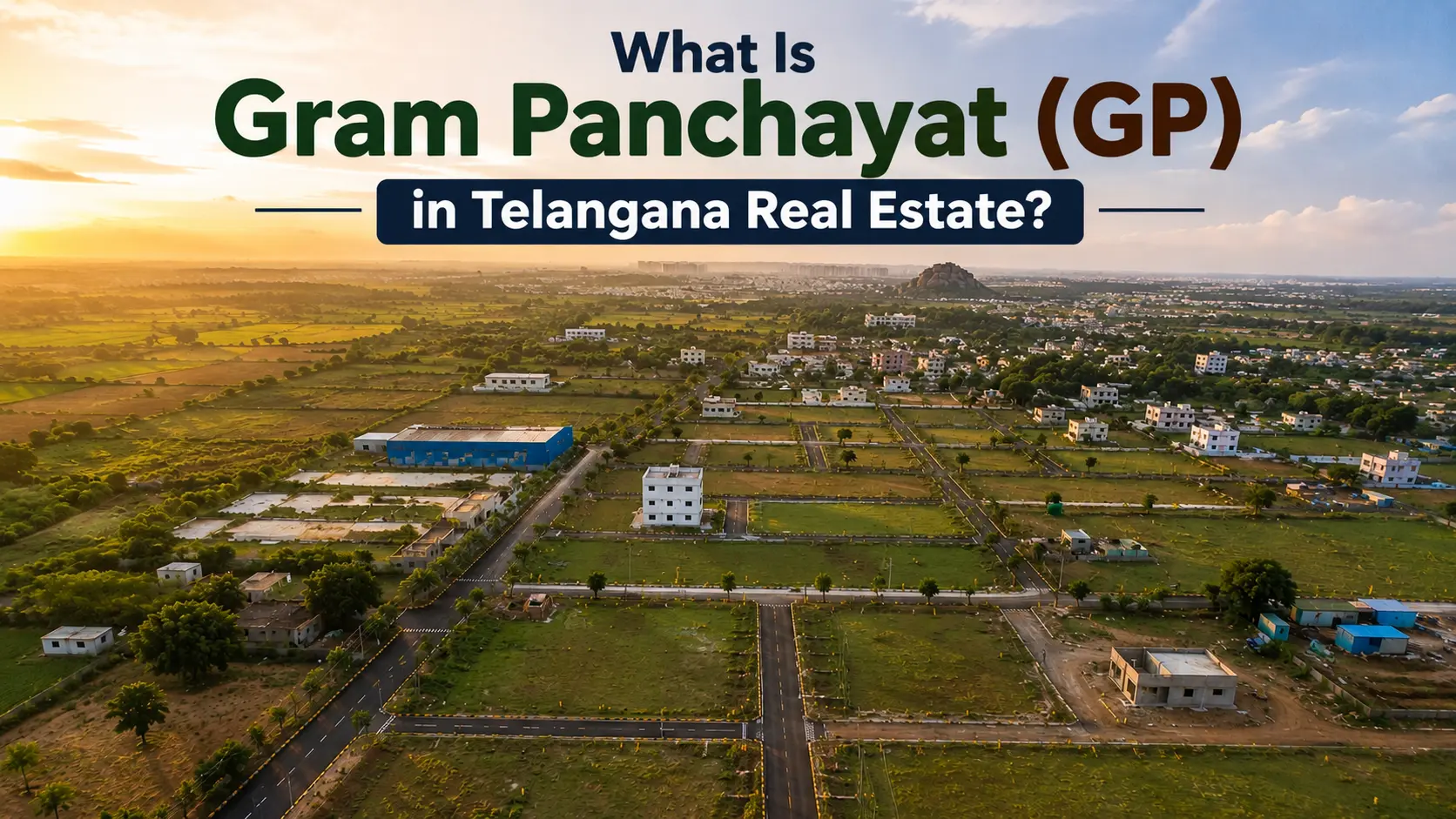
If you are searching for plots or houses around Hyderabad and towns in Telangana, you must have heard terms like “GP plots”, “Gram Panchayat layouts”, or “Panchayat approved plots”. For budget buyers and long‑term investors, these options look very attractive – but they also come with unique risks.
In this article, we will break down what GP (Gram Panchayat) means in real estate in Telangana, how it impacts home buyers and investors, and what you should check before taking a decision.
Understanding Gram Panchayat (GP) in Telangana Real Estate
A Gram Panchayat is the local self‑government body at village level – you can think of it as the basic “local body” for rural areas, just like a municipality or municipal corporation in urban areas. In real estate, when people say “GP plot” or “Gram Panchayat layout”, they usually mean:
- The land is located in a village or peri‑urban area, under a Gram Panchayat jurisdiction.
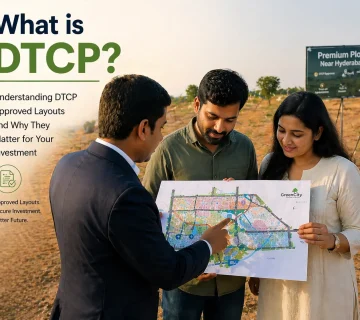
- The layout is approved at the Panchayat level, not by urban development authorities like HMDA or DTCP.
- Basic permissions for subdivision and internal roads are taken from the Gram Panchayat, but master‑planning standards are usually more relaxed compared to city limits.
In simple words: GP plots are village‑level approved plots, typically outside HMDA or municipality limits, often at a much lower price bracket.
Because Telangana’s cities like Hyderabad, Warangal, Nalgonda, Siddipet and others are expanding fast, many surrounding villages are getting converted into real estate hubs. That is why GP layouts have become a hot topic among both end‑users and investors.
Why GP Plots Attract Home Buyers
For many first‑time buyers, especially middle‑class families, GP layouts look like the easiest way to enter the property market. Here’s why they are so popular:
- Lower Entry Price: GP plots are usually 20–40% cheaper than comparable plots in HMDA or municipality‑approved layouts in the same belt. This makes them attractive for people with limited budgets.
- Larger Plot Sizes: In many GP layouts, you will find bigger plot sizes (200–300 sq. yds or more) at prices where you barely get 120–150 sq. yds in an HMDA project closer to the city.
- Scope for Independent Houses: Buyers who dream of building a G+1 or duplex independent house with some open space often prefer GP layouts over cramped city plots.
- Future Appreciation Hopes: As city boundaries expand and infrastructure like highways, regional ring roads, pharma/IT hubs and industrial parks come up, buyers expect strong appreciation in these peri‑urban GP areas.
For self‑use buyers, the emotion is strong: “Abhi sasta hai, kal yahi area develop hoga” – buy now while it’s affordable, and wait for development.
The Hidden Risks for Home Buyers in GP Layouts
Along with benefits, Gram Panchayat plots come with some critical risks that every home buyer should understand clearly before investing.
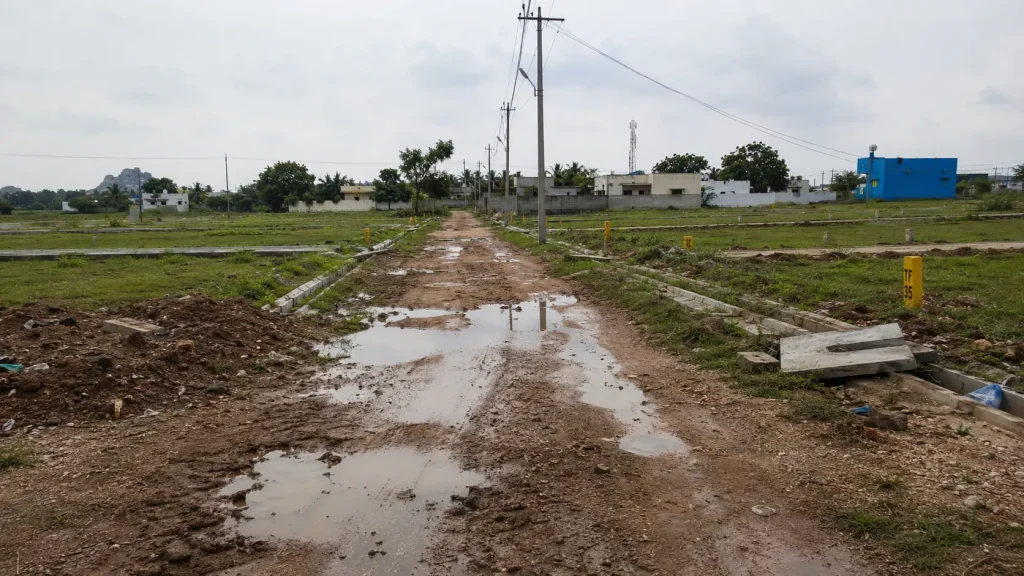
1. Legal and Approval Risks
- In many cases, land is originally agricultural, and proper conversion to non‑agricultural (NALA) may not be completed.
- Some layouts are just “Panchayat approved” on paper, but do not follow planning norms like road widths, setbacks and open spaces.
- Banks can be reluctant to give home loans for houses constructed on GP plots unless conversion and documentation are crystal clear.
If government launches regularisation drives (like LRS or similar schemes), property owners may have to pay additional charges to legalise their layouts.
2. Infrastructure and Livability Issues
Unlike HMDA or municipality‑approved layouts, GP areas usually do not have guaranteed infrastructure:
- Internal roads may be temporary or narrow, often damaged during monsoons.
- Water depends on borewells or private sources; no assured municipal water supply in many villages.
- Drainage and sewage are often not planned properly, leading to water‑logging or health issues.
- Streetlights, garbage collection and security are usually basic or handled informally.
So, even if the plot price is attractive, actual living conditions may be challenging for families planning to move in immediately.
3. Resale and Exit Challenges
Resale of GP plots or houses can be slower because:
- Many buyers now actively search for HMDA/DTCP‑approved or RERA‑compliant projects.
- Some financial institutions avoid funding against Panchayat‑approved layouts.
- If the area has legal or layout issues, even genuine buyers become cautious.
For you as a home buyer, this means you must enter with a long‑term horizon and be ready for a slower resale cycle compared to prime approved layouts.
GP Plots from an Investor’s Angle: High Risk, High Reward
From an investor’s perspective, GP layouts around growing cities in Telangana are like “frontier markets” – risky but potentially rewarding if chosen wisely.
Where Investors See Opportunity
- Urban Expansion: As Hyderabad and other cities keep expanding, today’s village can become tomorrow’s suburb. Well‑located GP plots near growth corridors, industrial nodes, ORR/RRR, or major highways can see significant appreciation over 5–10 years.
- Land Banking Strategy: Investors with a longer horizon often buy multiple GP plots, hold them for several years, and sell when city‑level approvals or infrastructure arrive.
- Rental Potential in Future: Once layouts get regularised and houses come up, independent homes in such areas can fetch decent rents, especially from working professionals looking for lower‑rent suburbs.
Key Risks Investors Must Respect
- Policy Changes: Government may tighten rules around layouts, registrations, or regularisation, which can impact liquidity and value.
- Speculative Pricing: In some pockets, prices are already inflated purely based on “future hype” with very limited real development on ground.
- Documentation Gaps: Poorly documented deals, unclear titles, or disputes at family level can block resale and legal construction.
In short, GP plots can deliver good returns only when you combine the right location with clean documentation and a realistic holding period.
Essential Checklist Before Buying a GP Plot in Telangana
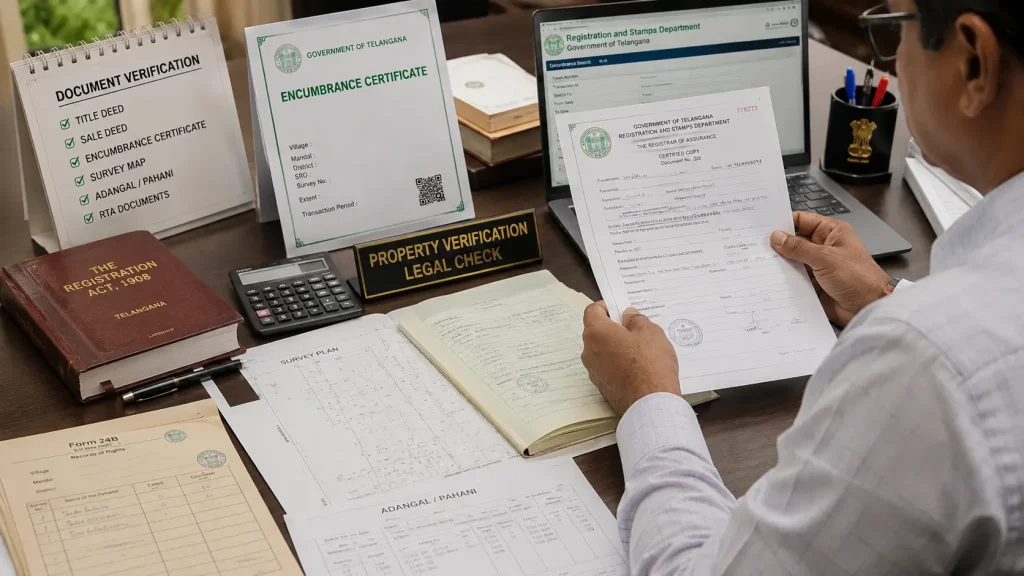
Whether you are a home buyer or an investor, do not rely only on marketing brochures or verbal promises. Use this practical checklist before committing to any GP property:
- Verify Land Title & Encumbrances
- Check the title chain for at least 30 years with a competent lawyer.
- Download and review Encumbrance Certificate (EC) from the Registration Department site.
- Confirm the land is not under legal dispute, government acquisition, or litigation.
- Check Land Use & Conversion
- Understand whether the land is agricultural or non‑agricultural.
- If agricultural, verify whether NALA (non‑agricultural conversion) is done or if you must do it.
- Ensure the survey numbers and plot numbers match on ground and on paper.
- Study Layout Plan & Road Access
- Ask for the approved layout sketch stamped by the Gram Panchayat.
- Verify road widths and access from the main road; avoid landlocked plots.
- Physically visit the site, walk through the layout and nearby houses/farms.
- Bank Loan Eligibility
- Even if you plan to buy with full cash, check if any nationalised or reputed private bank is willing to fund in that layout.
- If banks are refusing across the board, treat it as a red flag.
- Talk to Local Residents & Panchayat Office
- Speak with neighbouring landowners, shopkeepers and residents about any disputes or issues.
- Visit the Gram Panchayat office (or local revenue office) and casually cross‑check about the survey numbers and layout.
- Future Infrastructure & Master Plan
- Look at proposed roads, ring roads, industrial corridors, or town planning in that belt.
- A GP plot near future connectivity and job nodes has a better chance of appreciation and tenant demand.
Taking these extra steps might feel time‑consuming, but they can save you from years of stress and legal headache.
GP vs HMDA/DTCP: Which Is Better for You?
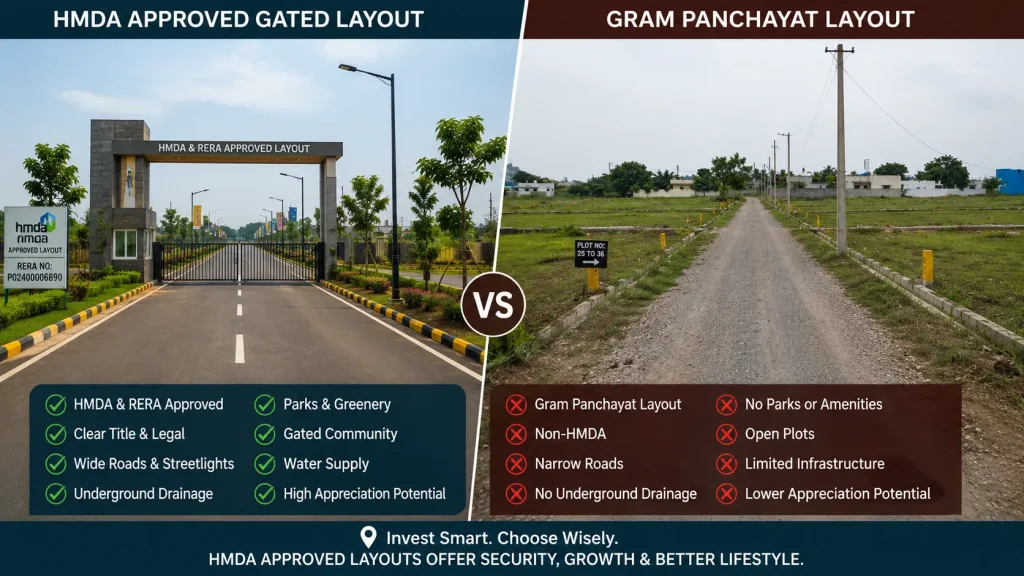
There is no single right answer because it depends on your goal, budget and risk appetite.
| Factor | GP (Gram Panchayat) Plots | HMDA/DTCP/Urban Layouts |
| Price | Lower entry cost | Higher but more stable |
| Approvals & Compliance | Basic village‑level approvals, often less stringent | Stricter norms, better planning |
| Infrastructure | Variable, usually developing | More assured roads, water, drainage, amenities |
| Bank Loan | Difficult in many cases | Easier, widely accepted |
| Risk Level | Medium to high | Low to medium |
| Appreciation Potential | High in right locations over long term | Steady and more predictable |
If you are a conservative home buyer who wants peace of mind and quick loan + resale options, an HMDA/DTCP/municipal‑approved property is usually safer.
If you are a calculated, long‑term investor and can handle documentation, patience and some risk, selected GP plots near strong growth corridors can work well.
Future Outlook: How GP Layouts May Evolve in Telangana
Telangana’s urbanisation is in a transition phase. As cities expand and new infrastructure comes up, GP areas around urban centres are slowly getting integrated into the wider development pattern.
Some key trends to watch:
- Stricter Regulation: Over time, the state is likely to tighten norms on layouts, registrations and development standards, even in village areas, to avoid haphazard growth.
- Regularisation & Upgradation: Many existing GP layouts may go through phases of regularisation and infrastructure upgradation, improving their long‑term value.
- Shift in Buyer Awareness: With more online information and exposure, buyers are becoming more aware of approval types, documentation and legal risk – which will push developers to be more transparent.
For both home buyers and investors, this means due diligence will matter even more than before. The old “just buy any village land and it will grow” mindset will not work in the new, more regulated environment.
Final Thoughts & Call to Action
Gram Panchayat (GP) plots in Telangana sit at the intersection of affordability, opportunity and risk. They give you:
- A lower‑cost entry into land ownership.
- A chance to build an independent house with more space.
- The possibility of strong long‑term gains if the area develops well.
But they also demand:
- Extra homework on legal, approval and infrastructure fronts.
- Patience with development timelines.
- A clear understanding of your own risk appetite.
Before you decide, pause and ask yourself:
- Are you buying mainly to live peacefully in the next 2–3 years, or to invest for 8–10 years?
- Is your priority lower price today, or higher security and liquidity in future?
- Have you personally verified documents and visited the Panchayat and revenue offices?
Take a notebook, list your answers, and discuss them with your family and a trusted real‑estate/legal advisor.
If you’ve already bought or are considering a GP plot in Telangana, share your experience and questions with others – your story might help another buyer make a smarter, safer decision.



 in Real Estate in Telangana? A Practical Guide for Home Buyers & Investors)