
If you are planning to buy a plot, farmhouse land or invest in a real estate project around Hyderabad, you will definitely hear the term NALA Conversion during your research. Before you pay token advance or book a plot, you must clearly understand what NALA Conversion is, whether the land is already converted, how the land conversion process works, and what can go wrong if you ignore it.
This guide is written specially for property buyers and investors in Hyderabad and Telangana. By the end of this article, you will understand A to Z about NALA Conversion – meaning, law, step‑by‑step process, documents, NALA conversion charges, time required, benefits, common mistakes and FAQs – so you can confidently evaluate any land or layout before buying.
What is NALA Conversion?
In simple words, NALA Conversion means converting agricultural land into non-agricultural land in government records so that it can be legally used for residential, commercial or industrial purposes.
In Telangana, this is regulated by The Telangana Agricultural Land (Conversion for Non‑Agricultural Purposes) Act, 2006 (Act 3 of 2006). The Act clearly says that no agricultural land in the State can be put to non‑agricultural use without prior permission of the competent authority and payment of conversion tax.
Full Form of NALA
- NALA: Non‑Agricultural Land Assessment.
- After conversion, your land falls under non‑agricultural land assessment and is treated as NA land for taxation and usage, instead of being treated as purely agricultural land.
This is why many people also search for NA land conversion or non-agricultural land conversion when they are studying this topic.
Why NALA Conversion is Required
Every land parcel in Telangana has a land‑use classification (agricultural or non‑agricultural) in revenue records like ROR 1B and Pattadar Passbook.
According to the 2006 Act, you cannot use agricultural land for non‑agricultural purposes (like houses, shops, factories, layouts) without getting prior conversion permission and paying conversion tax. If you do, the land is treated as “deemed converted” and the Revenue Officer can impose a penalty equal to 50% of the conversion fee.
Buyer takeaway: Before you buy any land near Hyderabad, always ask:
“Is this land agricultural in records or already converted to non‑agricultural (NALA)? Can you show the NALA conversion order or Non‑Agricultural land record?”
Why is NALA Conversion Important?
For a Hyderabad land buyer, NALA Conversion is critical from both legal and investment angles.
- Required for legal construction and approvals
- Municipal bodies and HMDA/DTCP expect the land to be in proper non‑agricultural status before granting building permission or layout approval.
- Under TS‑bPASS, NALA Conversions appear as a Revenue Department service with a timeline of 14 days, showing how tightly it is linked to building permission.
- Legal compliance and peace of mind
- If you buy land and start construction on agricultural land without conversion, you inherit the legal risk, not the previous owner.
- Revenue Officers can levy a 50% penalty over the NALA conversion fee and take action for unauthorized non‑agricultural use.
- Property value and resale
- Converted non‑agricultural plots (especially around ORR, Tukkuguda, Shankarpally, Patancheru, etc.) usually command higher prices than purely agricultural land because they are project‑ready.
- Buyers, builders, and investors feel safer paying more for land with clear land use conversion.
- Loan approvals and project finance
- Banks and housing finance companies look at land use during legal scrutiny; clearly converted NA land is much easier for home loan or construction loan approvals.
Buyer takeaway: Prefer plots where NALA Conversion is already done or where the conversion responsibility and cost are clearly written in the sale agreement.
When Do You Need NALA Conversion?
You need NALA Conversion whenever agricultural land is being used or proposed to be used for non‑agricultural purposes. Typical buyer scenarios around Hyderabad include:
- Building your own house or villa
- Buying a 200–400 sq. yards plot on the outskirts (Kollur, Adibatla, Ibrahimpatnam, etc.) for future home construction.
- Before you apply for TS‑bPASS building permission, the land should be converted to non‑agricultural.
- Buying plots in a real estate layout
- Investing in HMDA/DTCP layout plots sold as a “gated community” or “future villa community”.
- For proper layout approvals and long‑term safety, the underlying land use must be compatible with residential non‑agricultural use.
- Commercial development
- Purchasing roadside land for shops, office space, godowns, small warehouses or petrol bunks.
- This clearly counts as non‑agricultural and needs conversion.
- Industrial or institutional projects
- Land for factories, hospitals, schools, colleges or resorts must be NA as per records and zoning.
Buyer takeaway: Before booking, ask the seller:
“For this type of use (residential/commercial/industrial), is NALA already done? If not, who will do NALA and who will pay NALA conversion charges?”
NALA Conversion Process (Step-by-Step)
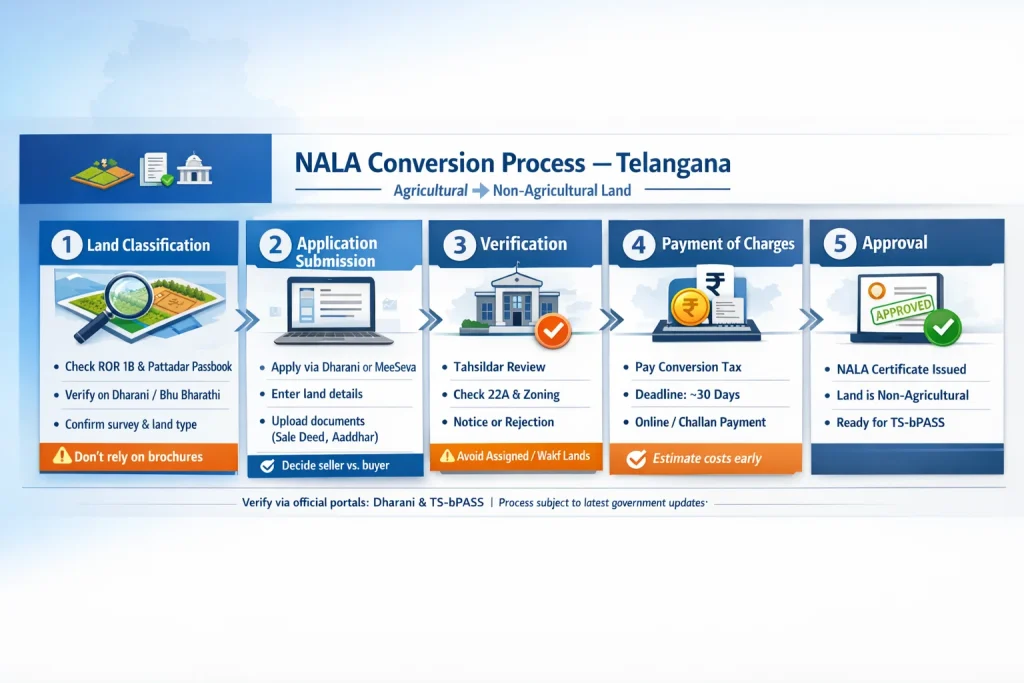
The actual online user interface keeps updating, but the core land conversion process in Telangana follows these main steps.
For latest instructions, always cross‑check with official portals:
- Dharani: https://dharani.telangana.gov.in
- TS‑bPASS timelines: https://tgbpass.telangana.gov.in/others/timelines
Step 1: Check Land Classification
Before anything, you must confirm whether the land you are planning to buy is shown as agricultural or non‑agricultural in revenue records.
- Check ROR 1B and Pattadar Passbook copies provided by the seller.
- Verify land details online through Dharani (for agricultural land) or Non‑Agricultural Dharani/Bhu Bharathi for NA properties.
What you should do as a buyer:
- Do not rely only on a brochure screenshot or Google Maps image.
- Independently open Dharani/Bhu Bharathi and confirm survey number, extent and land use classification.
Step 2: Submit Application
If the land is still agricultural and you (or the current owner) want to convert it:
- Go to the Dharani portal and choose the relevant NALA service (e.g., “Apply for NALA” or similar option).
- Log in and select the land using Pattadar Passbook number, district, mandal, village and survey number details.
- Fill the details of proposed land use – residential, commercial or industrial – and extent of agricultural land conversion.
- Upload required documents (sale deed, Pattadar Passbook, ROR 1B, EC, Aadhaar, etc.).
In some guides, applications can also be submitted through MeeSeva centres, where the operator forwards the application online to the Tahsildar and competent authority.
Buyer tip: Decide in the agreement of sale whether the seller will complete NALA before registration or you will apply after purchase.
Step 3: Verification by Authorities
- The application reaches the Tahsildar/Revenue Officer, who verifies ownership, land type, prohibited lands list (22A), and master plan/zoning conditions.
- If the land is eligible and there are no disputes or prohibitions, the authority proceeds to issue a demand notice for NALA tax.
If there are issues (assigned land, government land, Wakf land, FTL buffer zone, etc.), conversion can be refused and you may be asked for clarifications or additional documents.
Step 4: Payment of Conversion Charges
Once your NALA application is accepted:
- The competent authority issues a demand notice mentioning the NALA conversion charges (conversion tax) you have to pay.
- You typically get 30 days from the date of the notice to pay the conversion tax; payment is made online or via challan as instructed.
As per the Act and later amendments, conversion tax is calculated as a percentage of the basic value of the land, with rates notified by the Government (for example, 3% of basic value in some cases, subject to latest GOs).
Buyer budgeting tip:
Before buying, ask a local advocate or revenue consultant to estimate NALA charges for that survey number based on current basic value and latest NALA notification, so you can factor this into your total land cost.
Step 5: Approval Certificate Issued
- After you pay the conversion tax, the authority issues a NALA Conversion Certificate/Order, usually within about 30 days.
- The land is then officially treated as non‑agricultural and records are updated accordingly.
- In TS‑bPASS timelines, “NALA Conversions – Revenue – 14 Days” is shown as the service time for this approval in building permission workflow.
Only after this stage is your land fully ready for legal building permission or layout approval.
Documents Required for NALA Conversion
Exact documents can vary slightly by district and latest portal requirements, but generally you will need:
- Land ownership documents
- Latest registered sale deed / title deed in the owner’s name.
- Pattadar Passbook & ROR 1B
- To confirm private ownership and current land use classification.
- Encumbrance Certificate (EC)
- Latest EC (often 13 years) to show title history and any loans/charges.
- Survey documents & land sketch
- Survey number, sub‑division details and sketch showing the land area to be converted.
- Land revenue/tax receipts (if applicable)
- Proof that land revenue is paid up to date.
- Identity and address proof
- Aadhaar, PAN and address proof of the applicant.
- Undertaking/affidavit
- Declaration that land will be used according to approved non‑agricultural purpose and zoning rules.
You can also refer to the official Telangana Land Conversion Application Form on the national services portal:
NALA Conversion Charges
NALA conversion charges (conversion tax) are not fixed lump sum; they depend on:
- Location and land value
- Conversion tax is charged as a percentage of the basic value (circle rate) of the land, and the Government notifies these rates through GO/Amendment Acts.
- Purpose of use
- Industrial, commercial and residential uses may have different slabs and percentages; historically, different categories and population brackets carried different rates.
- Local regulations and updates
- The 2006 Act and the 2020 Amendment Act give Government power to revise these rates from time to time.
Because NALA conversion charges keep changing, you should:
- Check the latest applicable rate in government notifications or ask at the local Revenue office.
- Use the auto‑calculated NALA amount shown on Dharani or revenue portal at the time of application as the most reliable figure.
Buyer tip: If you are buying from a developer, ask them to clearly break up land cost + development cost + NALA conversion cost + registration cost so there is no confusion later.
Time Required for NALA Conversion
The time required for agricultural land conversion to NA land in Hyderabad and Telangana depends on document clarity and workload of the authorities, but available references show:
- Once application and documents are correct and accepted, the competent authority should issue the conversion certificate within about one month after payment.
- Some practical guides mention around 30 days to 2 months for the entire process from application to certificate, depending on objections and clarifications.
- In TS‑bPASS timelines, “NALA Conversions – Revenue – 14 Days” is given as the service time for processing NALA as part of building permission approvals.
Buyer expectation: If documents are clean and land is eligible, plan for roughly 2–4 weeks for NALA conversion, but factor in extra time for any queries/objections.
Benefits of NALA Conversion
From a buyer’s perspective, completing NALA Conversion before or soon after purchase brings powerful benefits.
- Legal approval for construction
- Your intended use (residential/commercial/industrial) matches what is recorded in revenue records and master plan/zoning.
- Higher land value and better resale
- Converted non‑agricultural plots are easier to sell, attract a wider buyer pool, and usually fetch a premium compared to raw agricultural land near Hyderabad.
- Easier bank loans
- Banks and NBFCs are more comfortable giving home loans, LAP or construction finance on NA land with proper conversion certificate and clear title.
- Suitability for layouts and gated communities
- For residential land conversion and layout approvals under HMDA/DTCP, having NALA done or being clearly eligible for conversion is almost a basic requirement.
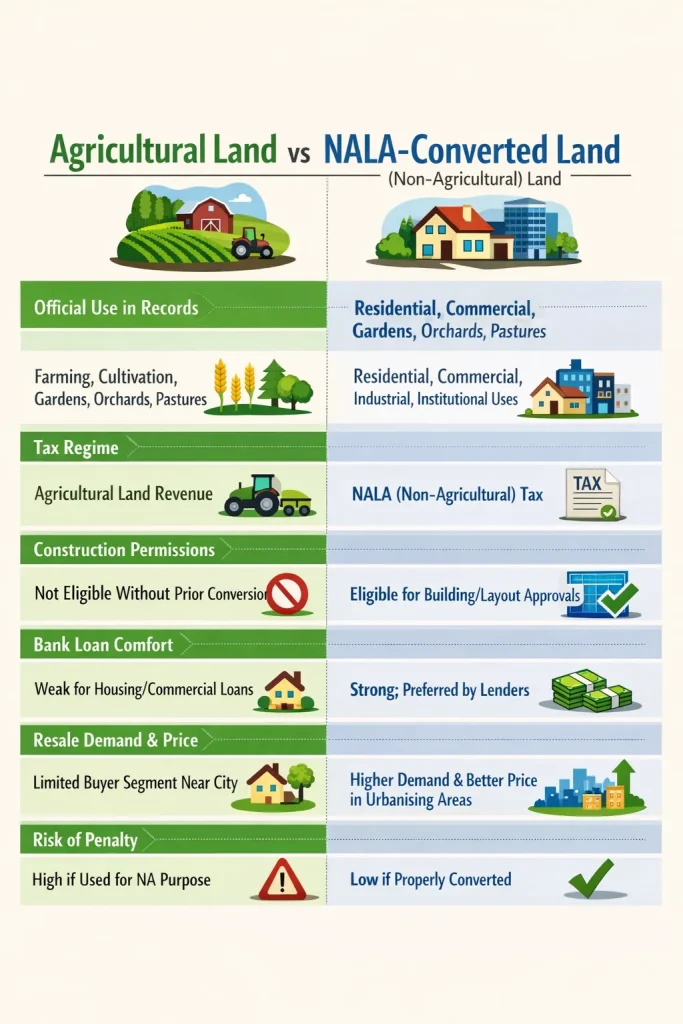
NALA Conversion vs Agricultural Land
| Parameter | Agricultural Land | NALA‑Converted (Non‑Agricultural) Land |
| Official use in records | Farming, cultivation, gardens, orchards, pastures | Residential, commercial, industrial, institutional uses |
| Tax regime | Agricultural land revenue | Non‑Agricultural Land Assessment (NALA) tax |
| Construction permissions | Not eligible without prior conversion | Eligible for building/layout approvals (subject to zoning) |
| Bank loan comfort | Weak for housing/commercial loans | Strong; preferred by lenders with conversion certificate |
| Resale demand & price | Limited buyer segment near city | Higher demand & better price in urbanising areas |
| Risk of penalty | High if used for NA purpose without permission | Low if properly converted and used as per norms |
Common Mistakes to Avoid During NALA Conversion
Before paying any advance for land around Hyderabad, avoid these land conversion mistakes:
- Not checking land records yourself
- Relying only on the seller/agent’s word or brochure without checking Dharani/Bhu Bharathi for land classification, ownership and extent.
- Ignoring encumbrance and title history
- Skipping EC and chain of link documents can expose you to old loans, disputes or double registrations that later block NALA and registration.
- Starting construction before NALA
- Building a house, shed or compound wall first and planning to “do NALA later” is risky; the law allows a penalty of 50% over and above conversion fee for deemed conversions.
- Buying on assigned/government/prohibited land
- Some lands (assigned, government, Wakf, FTL buffer zones, etc.) may not be eligible for conversion at all.
- No clarity on who pays NALA
- Many buyers assume the builder will do NALA, but later find it is their individual responsibility. Always write clearly in the agreement who will apply and pay for NALA conversion.
FAQs About NALA Conversion
Yes. As per the Telangana Agricultural Land (Conversion for Non‑Agricultural Purposes) Act, no agricultural land can be put to non‑agricultural use without prior permission and payment of conversion tax. Using agricultural land for housing, commercial or industrial use without conversion is a violation.
If any agricultural land in Telangana is used for non‑agricultural purposes without permission, the law treats it as “deemed converted” but allows the Revenue Officer to levy a penalty of 50% over and above the conversion fee. You still need to complete formalities and pay penalty plus tax to regularise.
In practice, NALA conversion usually takes around 30 days to two months from application to certificate, if documents are clear and there are no disputes. Under TS‑bPASS timelines, the Revenue Department’s service time for “NALA Conversions” is 14 days within the building permission workflow.
Technically, building a house on agricultural land without prior conversion is using the land for non‑agricultural purpose in violation of the Act and can attract the 50% penalty and other legal issues. For safe and legal construction, convert the land first and then apply for TS‑bPASS building permission.
In Andhra Pradesh, agricultural land conversion is governed by separate state rules (Agricultural Land Conversion for Non‑Agricultural Purposes rules), and applications are often routed through MeeSeva with one‑time conversion tax. While the concept is similar (you cannot use agricultural land for non‑agricultural uses without conversion), exact rates, forms, and portals differ from Telangana.
If you are buying in Hyderabad or anywhere in Telangana, always follow Telangana‑specific rules, Dharani portal, and TS‑bPASS guidelines.
Final Checklist for Hyderabad Land Buyers (NALA Focus)
Use this simple checklist before you freeze any deal:
- Check land details on Dharani/Bhu Bharathi – ownership, survey number, land use, extent.
- Ask: “Is this land already NALA‑converted?” If yes, insist on seeing the conversion order / certificate.
- If not converted, clearly decide in writing who will apply for NALA and who will pay NALA charges.
- Collect and verify EC (13 years), Pattadar Passbook, ROR 1B and link documents through a local advocate.
- Check master plan/zoning (residential/commercial/industrial/green buffer) before assuming any usage.
- Take a rough estimate of conversion tax based on current basic value and official NALA rate so your budget is realistic.
- Only after this due diligence, proceed to agreement of sale and registration.
Useful Official & Reference Links
- Dharani – Telangana Integrated Land Records: https://dharani.telangana.gov.in
- TS‑bPASS Timelines: https://tgbpass.telangana.gov.in/others/timelines
- Telangana Land Conversion Application Form: https://services.india.gov.in/service/detail/telangana–land-conversion-application-form
- PRS/IndiaCode – Telangana Agricultural Land (Conversion for Non‑Agricultural Purposes) Act, 2006: https://www.indiacode.nic.in/bitstream/123456789/8710/1/act_3_of_2006.pdf