
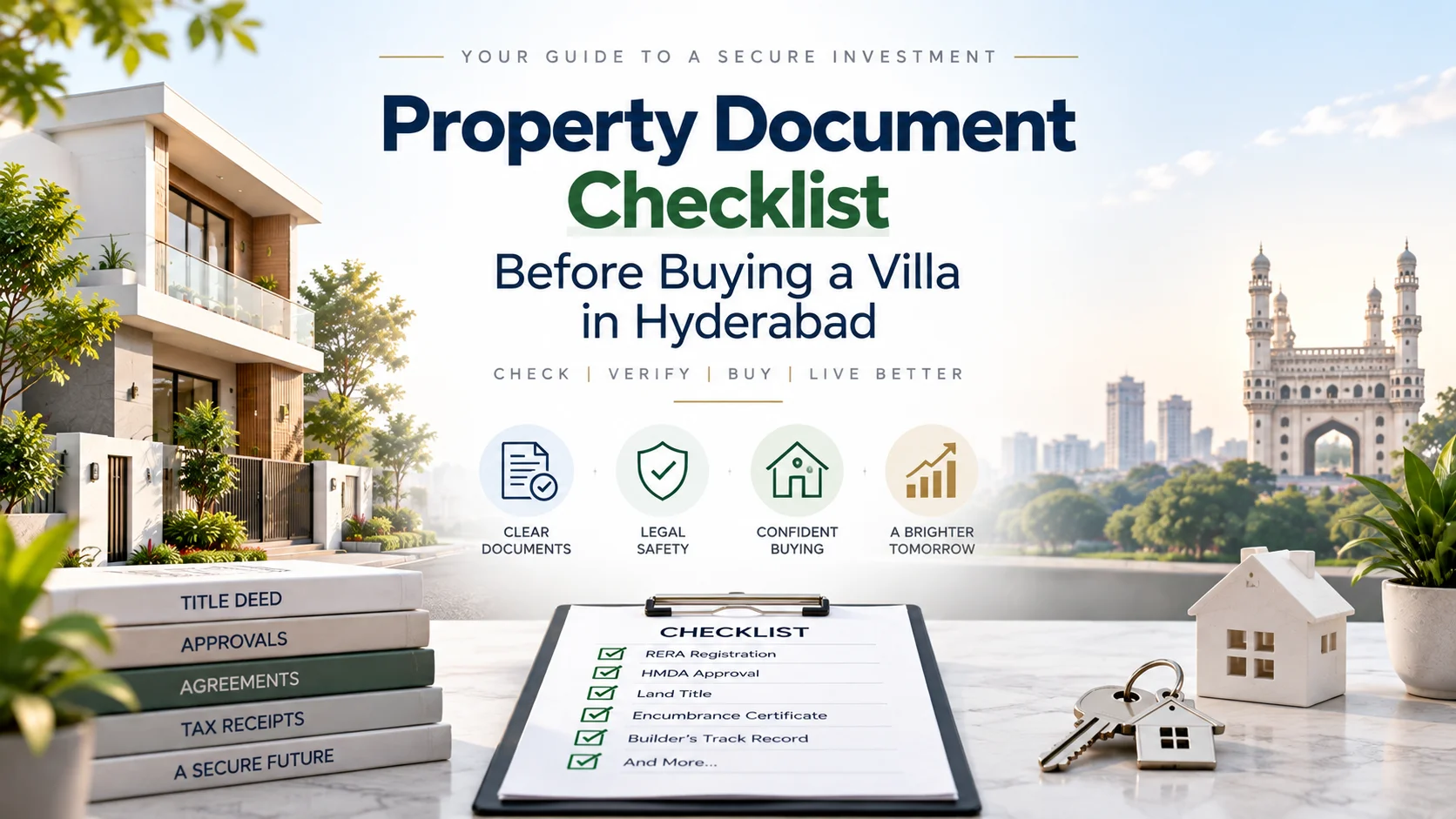
If you are planning to buy a villa in Hyderabad, this property document checklist before buying a villa can help you understand which documents to ask the seller or developer for and what you should verify before proceeding with the purchase.
Buying a villa is a major financial decision, and the property you choose should be evaluated beyond its location, design, amenities, and price. Before paying a booking, amount or signing a sale agreement, you should carefully verify the property’s legal, ownership, approval, and registration documents.
A villa may look perfect on paper, but missing title documents, unapproved layouts, construction permission issues, encumbrances, or discrepancies in land records can create serious problems later.
Important: Property documentation can vary depending on the location, project, land history, and type of transaction. For a high-value purchase, have the documents independently reviewed by a qualified property lawyer before signing or making a substantial payment.
Property Document Checklist Before Buying a Villa
Before buying a villa in Hyderabad, review the following documents:
| Document | What You Should Verify |
| Sale Deed / Title Deed | Current legal ownership |
| Mother Deed / Link Documents | Ownership history |
| Encumbrance Certificate | Existing mortgages, charges or registered transactions |
| Approved Layout Plan | Whether the layout has the required approval |
| Building Permission | Whether villa construction was permitted |
| Occupancy / Completion Certificate | Whether applicable completion and occupancy approvals exist |
| RERA Registration | Project registration and disclosed project details |
| Land Records | Survey number, extent and ownership details |
| Property Tax Receipts | Outstanding tax dues |
| Sale Agreement | Terms, obligations and promised specifications |
| No-Dues Documents | Outstanding liabilities, where applicable |
| Seller/Developer Documents | Identity, authority and ownership rights |
The exact documents required can differ from one villa project to another, so treat this as a due-diligence framework rather than a substitute for legal verification.
1. Sale Deed and Title Deed
The first question to answer is simple:
Who legally owns the property?
The title deed and relevant sale deeds should establish the ownership of the land and property.
Check:
- Name of the current owner
- Property description
- Survey number
- Land extent
- Boundaries
- Document registration details
- Previous ownership references
- Whether the seller’s name matches the ownership records
Do not rely only on a photocopy provided by a salesperson. Ask for the relevant registered documents and have the ownership chain reviewed.
For a villa project, the legal ownership of the underlying land is particularly important because the villa and the land on which it stands are connected to the project’s title structure.
2. Mother Deed and Link Documents
The current sale deed does not always tell the complete story of how the property came to be owned by the present seller.
This is where mother deed and link documents become important.
Link documents help establish the chain of ownership through previous transactions.
Depending on the property’s history, these may include:
- Earlier sale deeds
- Partition deeds
- Gift deeds
- Release deeds
- Settlement documents
- Inheritance-related documents
- Other registered instruments affecting ownership
You should check whether the ownership chain is continuous and whether there are unexplained gaps.
HMDA’s own documentation checklists for development permissions have historically included ownership documents, title deeds, link documents and the latest encumbrance certificate among the documents submitted for scrutiny.
Why this matters
A seller may have a registered document, but that alone does not necessarily mean there are no historical title issues.
A property lawyer should examine the chain of title and identify any potential gaps, disputes, claims or inconsistencies.
3. Encumbrance Certificate (EC)
The Encumbrance Certificate is another important document to check before buying a villa.
An EC can help identify registered transactions and encumbrances affecting the property during the period covered by the certificate.
Check for:
- Registered mortgages
- Charges
- Sale transactions
- Other registered instruments
- Whether the EC period is adequate for the legal review
Do not treat an EC as a complete guarantee that a property has no legal problems. It should be considered together with the title documents, link documents and other relevant records.
If the seller says that an old loan has already been cleared, ask for appropriate evidence of the release/closure rather than relying only on a verbal assurance.
4. Approved Layout Plan
For a villa project, the layout itself needs to be examined.
Ask for the applicable approved layout plan and compare it with the property being sold.
Check:
- Project boundaries
- Villa plot number
- Survey numbers
- Internal roads
- Open spaces
- Common areas
- Amenities
- Access roads
- Number and location of villas
- Whether the actual development corresponds with the approved plan
This is especially relevant when purchasing a villa in a large gated community.
HMDA provides planning and layout permission services, and its development-permission process includes title scrutiny and document review.
5. HMDA Approval and Applicable Planning Permissions
If the villa project falls within the relevant HMDA planning jurisdiction, verify the applicable planning permissions rather than accepting statements such as “HMDA approved“ without supporting documentation.
Ask the developer or seller for the relevant approval details and verify:
- Approval/reference number
- Approved layout
- Approved land extent
- Survey numbers
- Conditions attached to the approval
- Whether the development on site corresponds with the approved permissions
HMDA states that building permissions, occupancy certificates and layout permissions within the relevant HMDA jurisdiction are now processed through TG-bPASS, subject to the applicable rules.
Don’t confuse layout approval with building approval
These are not necessarily the same thing.
A project can have an approved layout while individual construction permissions and completion/occupancy documentation require separate verification.
That distinction is important when buying a completed or under-construction villa.
6. Building Permission
The villa itself should have the appropriate construction permission applicable to the project.
Ask to see the sanctioned or approved building plan and relevant permission documentation.
Compare the approved plans with the actual villa.
Look for potential differences in:
- Built-up area
- Number of floors
- Setbacks
- Villa footprint
- Parking
- Extensions
- Structural additions
- Other significant modifications
An attractive villa with unauthorized alterations can create problems during future sale, financing, regularization or other property-related processes.
7. Completion Certificate and Occupancy Certificate
For a completed villa, ask whether the applicable Completion Certificate (CC) and Occupancy Certificate (OC) have been obtained.
These documents are relevant because they provide evidence that the completed development has gone through the applicable approval process.
The exact documentation can depend on the nature and location of the project.
HMDA lists occupancy certificates as part of its planning/development permission services.
If a builder says that an OC or completion document is “under process,” understand exactly what remains pending before making a final decision.
8. TG RERA Registration
For an applicable new or ongoing villa project, check the project’s registration with the Telangana Real Estate Regulatory Authority (TG RERA).
Do not rely only on a brochure or salesperson’s statement.
Check the project’s official RERA record and compare the information with what the developer is selling.
Look at:
- Project name
- Promoter/developer name
- Project location
- Survey details
- Registered project details
- Declared completion timeline
- Approved/project-related documents available through the RERA record
- Project updates, where applicable
TG RERA provides a public project-registration system and currently lists thousands of registered projects and agents.
TG RERA’s published forms and documents also include project-registration and agreement-related materials.
Important
RERA registration does not replace title verification.
A buyer should still independently verify ownership, encumbrances, approvals and other legal aspects of the property.
9. Land Records and Survey Details
Before buying a villa, pay close attention to the land on which the project is developed.
Verify:
- Survey number
- Sub-division details, where applicable
- Total land extent
- Boundaries
- Ownership details
- Land classification/use where relevant
- Consistency between land records and project documents
The survey number appearing in the sale documents, approved layout, project records and other relevant documentation should be consistent.
Any unexplained mismatch deserves investigation before proceeding.
10. Land Use and Conversion Documents
Depending on the property’s history and location, verify whether the land has the appropriate land-use status and whether any required conversion or related permissions have been obtained.
This is particularly important when agricultural or other land has been developed into a residential project.
Do not assume that because villas have already been constructed, every underlying land-use issue has automatically been resolved.
Ask for the applicable documentation and have it reviewed professionally.
11. Property Tax Receipts
Ask for recent property tax receipts and verify whether there are outstanding dues.
Check:
- Property identification details
- Owner’s name
- Tax period
- Paid amount
- Outstanding dues
- Any notices or arrears
Tax receipts are not proof of title, but they are useful as part of the overall property due-diligence process.
12. No-Dues and Outstanding Liabilities
Depending on the project, there may be other financial obligations connected with the property.
Ask about:
- Property tax dues
- Maintenance dues
- Utility dues
- Developer dues
- Association dues
- Bank or mortgage liabilities
- Other charges affecting the property
If a villa is mortgaged, make sure the process for clearing the lender’s interest and obtaining the necessary release documentation is clearly established before registration.
13. Sale Agreement
Never treat the sale agreement as routine paperwork.
Read it carefully before signing.
The agreement should clearly identify matters such as:
- Villa number
- Plot/land details
- Sale consideration
- Payment schedule
- Possession date
- Construction specifications
- Amenities
- Common areas
- Parking
- Maintenance obligations
- Default provisions
- Cancellation/refund terms
- Registration obligations
- Other commitments made by the developer
If the sales team has made important promises verbally, ask whether they are properly reflected in the contractual documents.
A brochure or WhatsApp message is not a substitute for a properly drafted agreement.
Documents to Check Before Paying a Villa Booking Amount
One of the biggest mistakes buyers make is paying a significant booking amount first and starting legal verification afterward.
Ideally, reverse that process.
Before making a substantial payment, ask for the key documents that allow you to assess:
- Who owns the land?
- Does the seller/developer have the right to sell?
- Is the project appropriately approved?
- Is the project registered with TG RERA where applicable?
- Are there encumbrances?
- Does the villa correspond with the approved plans?
- Are there unresolved legal or financial issues?
- What exactly are you agreeing to purchase?
A small amount of document verification before committing can prevent a much larger problem later.
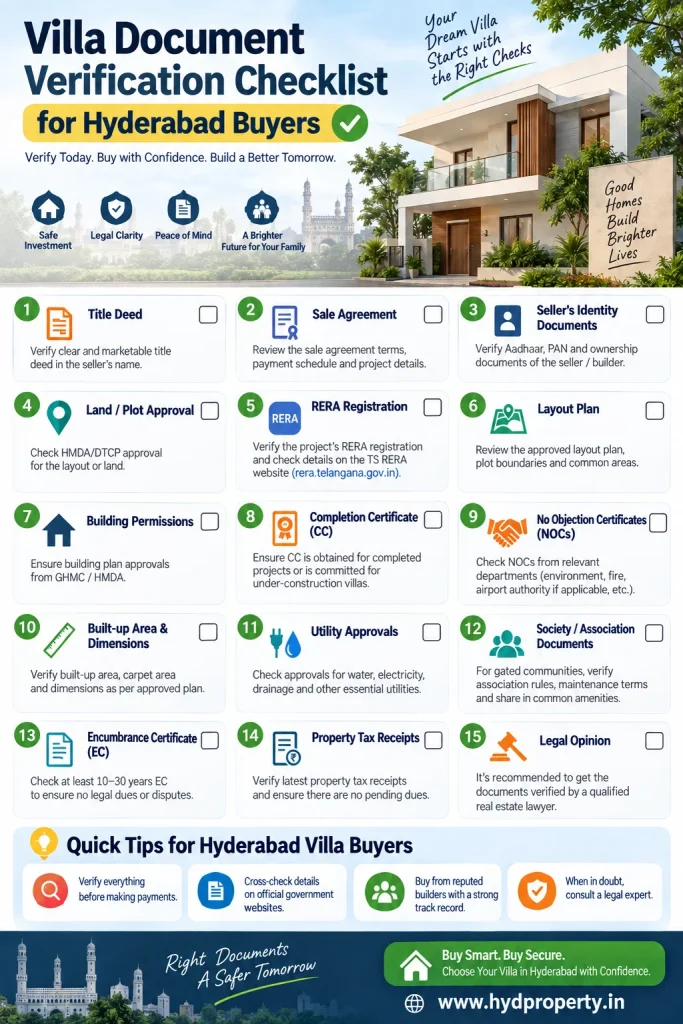
Villa Document Verification Checklist for Hyderabad Buyers
You can use this quick checklist when evaluating a villa:
| Check | Verified? |
| Current title/sale deed reviewed | ☐ |
| Mother/link documents reviewed | ☐ |
| Encumbrance Certificate checked | ☐ |
| Land survey details verified | ☐ |
| Land extent and boundaries verified | ☐ |
| Layout approval verified | ☐ |
| Applicable HMDA/local approval verified | ☐ |
| Building permission checked | ☐ |
| Approved building plan compared with villa | ☐ |
| Completion/Occupancy documentation checked | ☐ |
| TG RERA registration checked, where applicable | ☐ |
| Property tax dues checked | ☐ |
| Other outstanding dues checked | ☐ |
| Sale agreement reviewed | ☐ |
| Seller/developer’s authority verified | ☐ |
| Independent legal opinion obtained | ☐ |
Common Red Flags When Buying a Villa
Be particularly careful if you encounter any of the following:
- All documents are with the lawyer: Ask for access to the relevant documents yourself and have your own legal adviser review them.
- Pressure to pay immediately: A limited-time discount should not force you to skip legal due diligence.
- Mismatch in survey numbers: Differences between the sale deed, layout, RERA record and other documents should be investigated.
- Missing link documents: An incomplete title chain can require further investigation.
- Construction differs from the approved plan: Don’t assume that every deviation is automatically acceptable.
- Unclear mortgage status: If the land or project is financed, understand exactly how the lender’s interest will be released.
- RERA registered, so everything is legal: RERA registration should not be treated as a replacement for independent title and approval verification.
- Verbal promises about amenities: If an amenity, specification or possession commitment is important to your decision, ensure the contractual documentation supports it.
Should You Hire a Property Lawyer Before Buying a Villa?
For a significant villa purchase, independent legal due diligence is strongly advisable.
A property lawyer can review the title chain, encumbrances, approvals, land records, agreements and other documents and identify issues that a buyer may not recognize.
This is particularly important when:
- The property has a complicated ownership history
- The project is large
- The land has changed hands multiple times
- There are mortgages or development agreements
- The project is under construction
- Documents contain inconsistencies
- The seller is asking for a substantial advance
- You are purchasing an expensive luxury villa
The cost of professional verification is generally small compared with the financial exposure involved in a property purchase.
Final Checklist Before Buying a Villa in Hyderabad
Before you finalize your villa, don’t evaluate only the floor plan, interiors, location and amenities.
Verify the property itself.
Your due-diligence checklist should cover:
Ownership → Title → Link Documents → EC → Land Records → Layout Approval → Building Permission → Completion/Occupancy Documentation → RERA → Taxes/Dues → Sale Agreement → Independent Legal Review
For Hyderabad buyers, also pay close attention to the applicable HMDA/local planning permissions and Telangana RERA records.
A beautiful villa is only a good purchase when the underlying property documentation is also in order.
Frequently Asked Questions
At a minimum, review the title/sale deed, mother and link documents, Encumbrance Certificate, land records, approved layout, applicable building permissions, completion/occupancy documentation, RERA registration where applicable, tax records and sale agreement. An independent property-lawyer review is recommended.
Check the project through the official Telangana RERA portal and compare the registered project details with the documents and information provided by the developer.
No. RERA registration should be one part of your due diligence. Buyers should separately verify title, ownership, encumbrances, land records, approvals, construction permissions and contractual documents.
An EC can help identify registered transactions and encumbrances recorded during the period covered by the certificate. It should be reviewed together with the title chain and other property documents.
If the project falls within the relevant HMDA planning jurisdiction, you should verify the applicable planning and building permissions. HMDA provides planning, layout and building-permission services for properties within its jurisdiction.
You can make the purchase without independent legal advice, but for a high-value transaction it is generally prudent to have the title and property documents reviewed by a qualified property lawyer before making a substantial commitment.
Before making a significant booking payment, establish the ownership/title position, review the major approval documents, check RERA registration where applicable, understand any encumbrances or liabilities, and review the booking/sale agreement carefully.
Disclaimer
This checklist is provided for general informational purposes and is not a substitute for legal, financial or professional property advice. Property documentation and approval requirements can vary depending on the location, project structure, land history and transaction. Buyers should independently verify documents and obtain professional legal advice before purchasing a villa.
