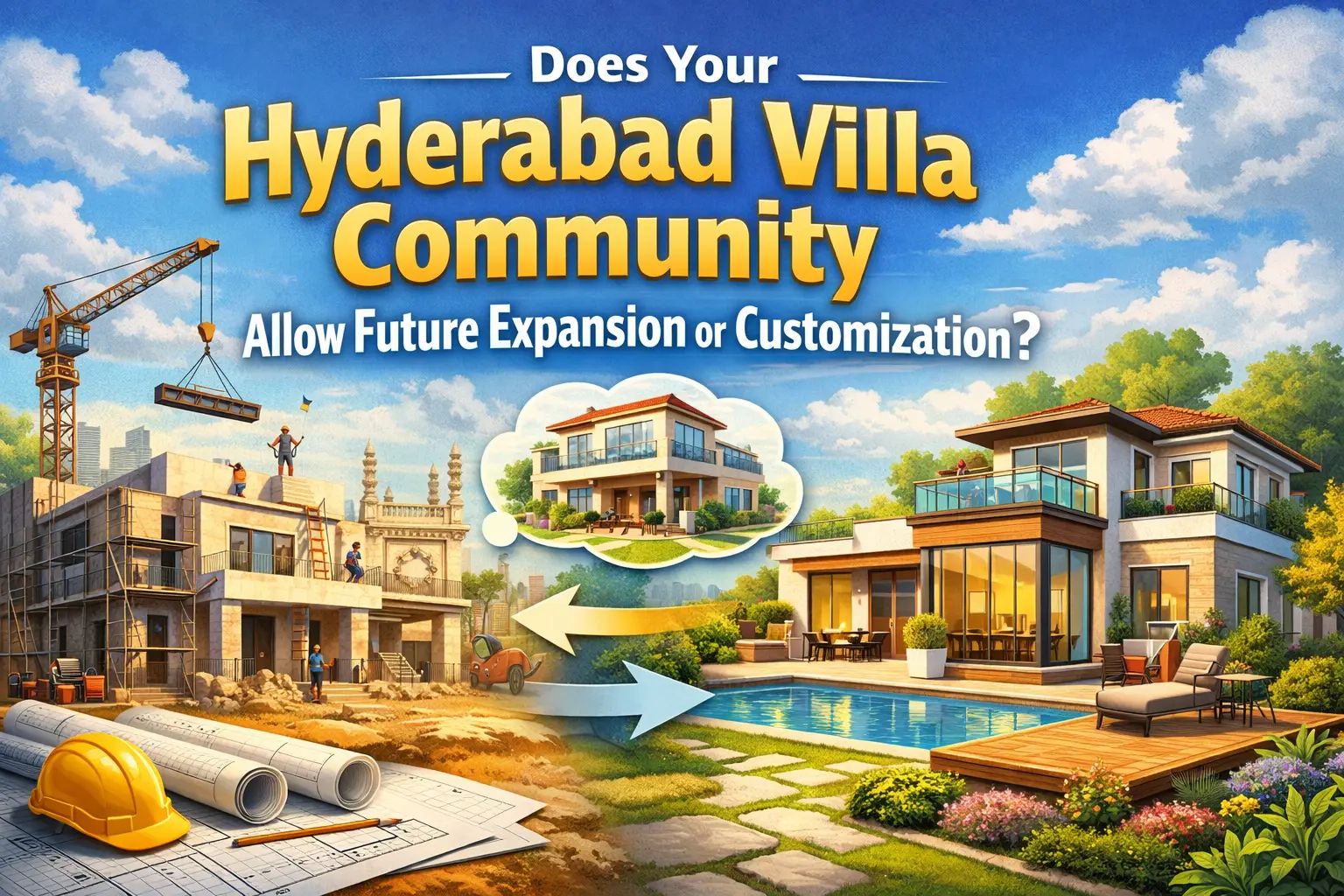
When you book a gated villa community in Hyderabad, you are not just buying a villa you are buying into a long‑term master plan, community by‑laws, and shared infrastructure. One crucial but often ignored question buyers should ask is: “Does this villa community have a provision for future expansion or customization?”
With villa projects spreading across growth corridors like Narsingi, Mokila, Tellapur, Shankarpally and Tukkuguda, buyers increasingly look for homes that can adapt to changing family needs without creating legal or structural headaches later.
Why future expansion matters in a gated villa community
Many Hyderabad families buying Hyderabad gated community villas plan to stay for 15–20 years, so their needs naturally evolve extra bedrooms for children, a home office, space for parents, or a rental portion for extra income. Instead of selling and upgrading to a bigger property (which means higher prices and stamp duty), it is often more practical to extend or customize the existing villa if the community and approvals allow it.
Gated villa townships also tend to appreciate faster than standalone properties because of amenities, security and professional maintenance, so a future‑ready design can further boost long‑term resale value.
Master planning: how the layout controls your expansion options
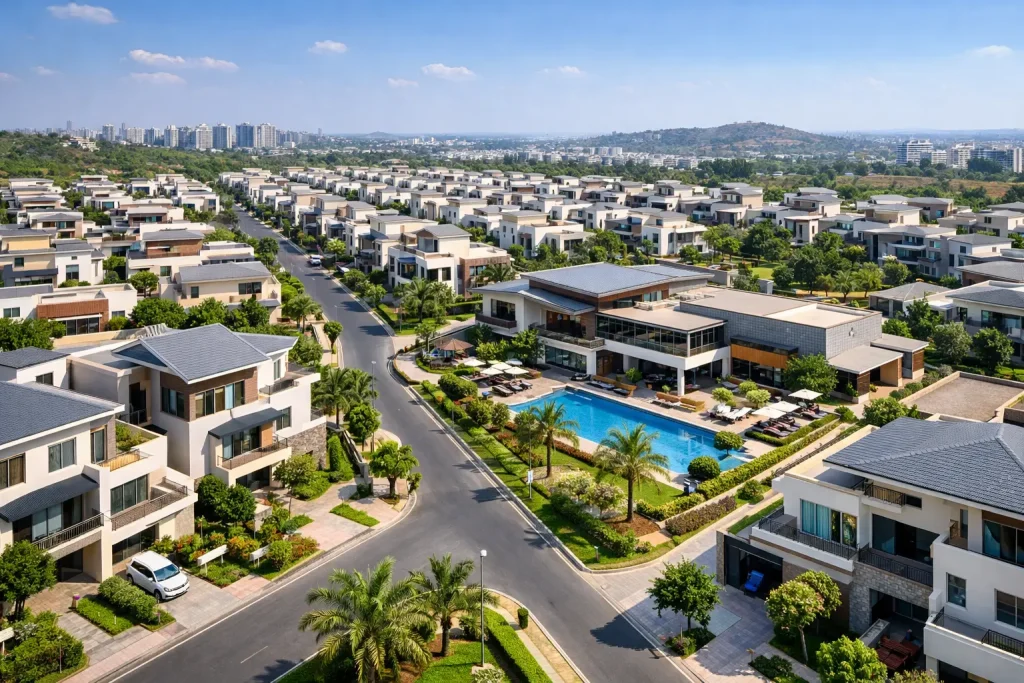
In a villa community, your scope for future expansion or customization starts at the master‑plan level, even before you look at your individual unit. Developers must follow HMDA zoning regulations on minimum open spaces, road width, civic amenities and overall density for the layout.
This has three important implications for buyers:
- Roads, parks, and the clubhouse are fixed common areas; you cannot legally extend your villa into these spaces even if there is “empty land” visually in front of your gate.
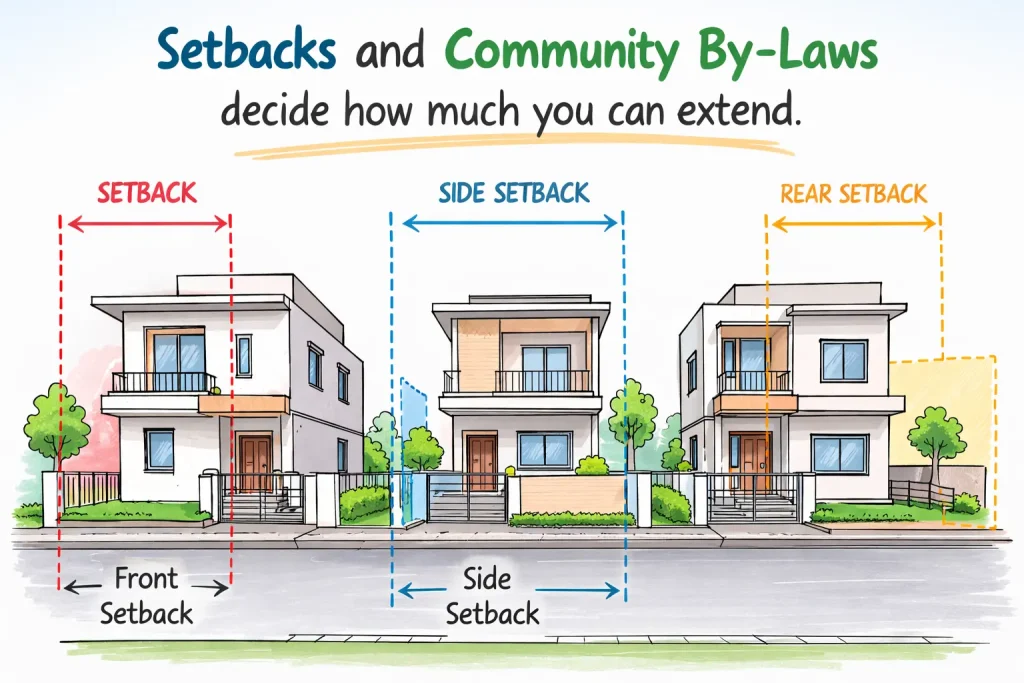
- Setbacks and built‑up area approved in the sanctioned layout and building plan limit how much you can push out your rooms or balconies.
- Any change that affects fire movement, parking or internal traffic flow is likely to be rejected by both authorities and the community association.
You can refer to the official HMDA Zoning Regulations and Master Plan PDF here for a technical overview of how layouts are controlled:
HMDA Zoning Regulations & Master Plan.
Structural design of villas inside the community
Even if the layout allows some scope, the structural design of each villa decides how safely you can expand or modify it later. If you are thinking about adding a room on the terrace, an extra floor, or extending over the car porch in future, check:
- Foundation capacity: Foundations and columns must be designed from day one to carry the potential extra loads of a future floor; retrofitting foundations in a finished villa is complex and expensive.
- Column and beam grid: Villas supported by a clear RCC column–beam system (rather than many random load‑bearing walls) are easier to extend or reconfigure internally.
- Roof type: Flat RCC roofs and simple slabs are much easier to build on than complicated multi‑level pitched roofs.
Most reputed developers in Hyderabad highlight their structure and engineering standards in brochures or technical specs. Do not hesitate to ask for structural drawings or a basic confirmation from the project engineer if “future expansion” is part of your buying decision.
Services and utilities: planning for future customization
In a Hyderabad villa community, utilities like water, sewage, storm‑water drains, and power backup are designed for the whole project, not only your individual villa. Poorly planned extensions can overload these shared systems. Look for:
- Extra plumbing and service shafts: If the builder has provided capped plumbing lines or shafts near terraces and balconies, it becomes easier to add a bathroom, utility or pantry later without breaking large portions of walls and flooring.
- Electrical capacity and conduits: Spare capacity in the main panel, additional conduits, and junction boxes make it simple to wire new rooms, enclose sit‑outs or upgrade to more appliances later.
- AC, ventilation and data: Provisions for additional indoor/outdoor AC units, cross‑ventilation and data cabling help if you convert open terraces or verandahs into closed family spaces or home offices.
Communities with underground cabling, STP plants and fiber connectivity, like many of the emerging luxury villa projects in Hyderabad, are usually better prepared for such phased upgrades.
HMDA/GHMC permissions and community by‑laws
In Hyderabad, future expansion or customization is always subject to two authorities:
- the government (HMDA/GHMC via TS‑bPASS), and
- the villa community’s own association and by‑laws.
HMDA and GHMC building rules specify height limits, setbacks, and permissible built‑up area for each plot and project. If you want to add a full extra floor, enclose a major balcony, or build a new external staircase, you may need a revised building permission or at least written clearance from the municipal body.
At the same time, the RWA / villa association may have strict rules to maintain uniform elevation and community aesthetics especially after the Telangana High Court asked the state to frame clearer guidelines for gated communities. Before finalizing a villa, always ask for:
- The community’s by‑laws and modification policy
- Any restrictions on terrace rooms, balcony enclosures, grills, pergolas or external staircases
Checklist: how to evaluate a future‑ready villa community
Use this practical checklist when you visit Hyderabad gated villa communities and want to judge their scope for future expansion or customization:
- Master plan and approvals
- Ask for the HMDA/HGHC‑approved layout and villa plans; check setbacks, number of floors and built‑up area.
- Confirm that the community is RERA‑registered and has clear land title.
- Structural design of villas
- Check whether the foundation and columns are designed to carry any future floor (sometimes mentioned as “designed for G+2” even if currently built G+1).
- Ask which internal walls are structural and which are lightweight partitions that can be altered later.
- Utilities and services
- Look for mention of spare plumbing lines, service shafts, and electrical capacity in brochures or technical handouts.
- Confirm that the STP, transformers and water systems can handle moderate internal changes without stressing the network.
- Community by‑laws and modification rules
- Request a copy of the draft by‑laws or at least a written note on what kind of structural and façade changes are allowed after handover.
- Clarify rules on enclosing balconies, adding grills, building pergolas or extra rooms on terraces.
- Builder’s clarity and track record
- Check how transparently the sales and technical teams answer expansion‑related questions compared to other Hyderabad gated community projects.
- Review the builder’s past communities have residents been allowed reasonable customizations without disputes?
Conclusion: choose a community that grows with you
So, does your Hyderabad villa community have a provision for future expansion or customization? The real answer lies in the combination of master plan, structural design, services, and rules, not just in verbal assurances during a site visit. A truly future‑ready gated villa project will clearly show in its drawings, engineering and by‑laws that homeowners can undertake reasonable, safe, and legally compliant changes as their lifestyle evolves.
When you evaluate Hyderabad gated villa communities, treat “future expansion and customization” as a serious decision factor, just like location, price or amenities. If you do this homework today, your villa will not only give you comfort now, but also the flexibility to grow with your family, without clashing with HMDA/GHMC rules or community regulations tomorrow.