Learn what Peri Urban Zone in Hyderabad means, its land use rules, development scope, HMDA zoning norms, and investment potential.
Life on the Edge of the City: Stories from Hyderabad’s Peri‑Urban Zones
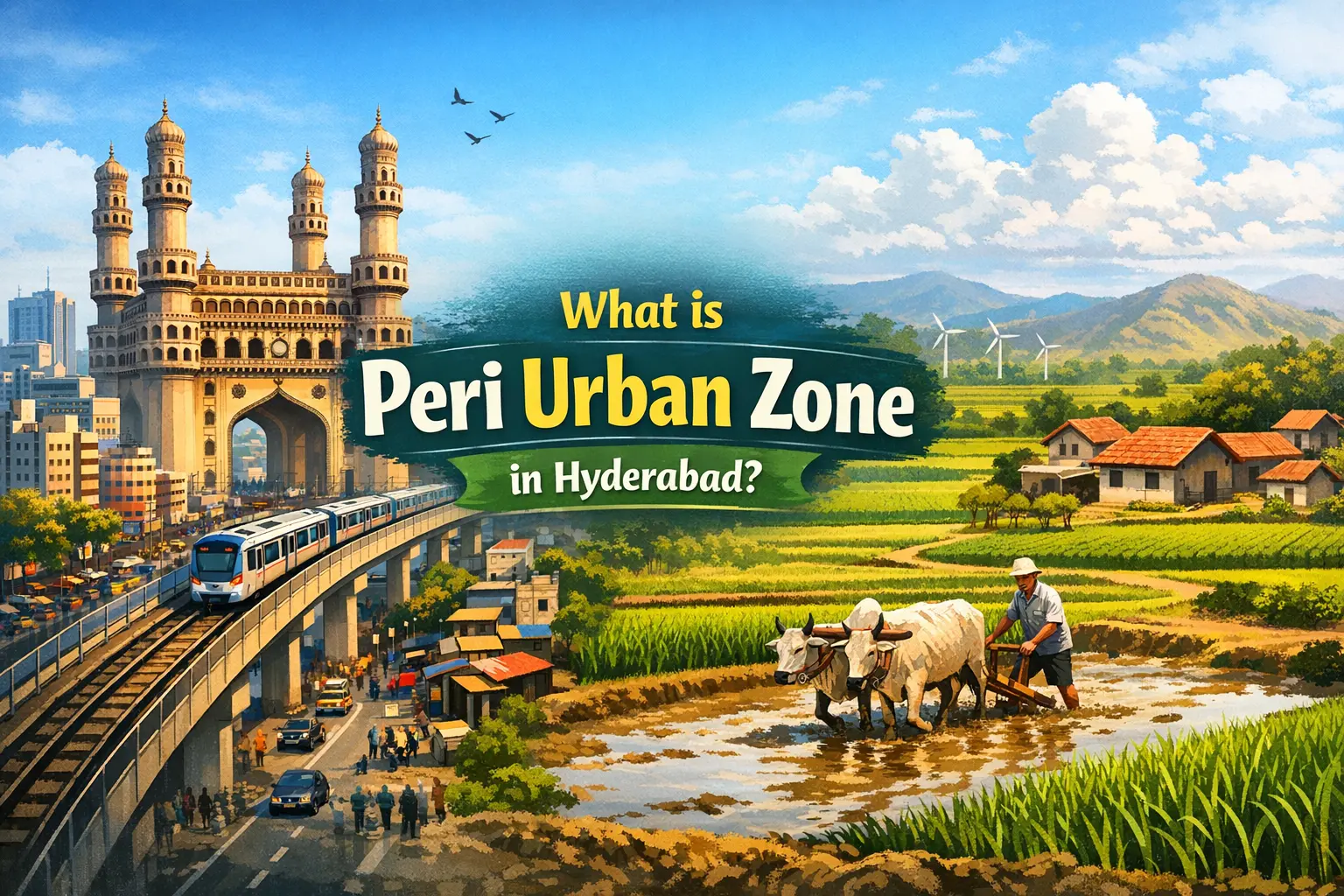
If you’ve ever taken a long drive on Hyderabad’s Outer Ring Road maybe towards Gachibowli, Kokapet, Shamshabad, or Medchal you’ve probably seen it.
On one side, shiny new apartments, billboards for “luxury villas” and IT parks.
On the other side, green fields, buffaloes lazily walking, small temples, and old village houses.
That “in‑between” world is what planners call the peri‑urban zone.
But beyond the fancy term, it’s really a story of people, emotions, and change.
This blog is about that story. About the people living at the edge of Hyderabad not fully city, not fully village and the feelings that come with it.
So, What Is a Peri‑Urban Zone… In Simple Words?
Forget the technical definition for a minute.
Imagine a circle. In the centre, you have the “main city” places like Banjara Hills, Ameerpet, old city areas, Hitech City.
Around that, you have another ring of areas that are growing fast, but still have a village touch places beyond the Outer Ring Road and towards the proposed Regional Ring Road. This is where a lot of land is changing from farms to layouts, from small houses to gated communities.
That ring is the peri urban zone where Hyderabad is stretching its arms and slowly pulling nearby villages into its hug, whether they are ready or not.
It’s in these areas that:
- Farmers become landlords… and then sometimes employees.
- Village kids start going to English‑medium schools next to big international schools.
- Families move for “better future” but secretly miss the old courtyard, the neem tree, the slow evenings.
Story 1: The Family That Moved “Just a Little Further”
Picture this.
Ramesh and Anitha used to live in a small rented portion near Mehdipatnam. Ramesh works in a support job for an IT company in the Financial District. Every day, two hours in traffic, crowded buses, and endless honking.
When their landlord suddenly increased the rent, they did what many middle‑class families do they looked “a little outside” the city.
They found a 2BHK flat near Kollur, just beyond the busy parts, closer to the ORR. Rent was slightly cheaper, the flat was bigger, and the builder proudly said, “Future Financial District extension, sir!”
On their first night there, their son stood in the balcony and said,
“Amma, stars! We can actually see stars here.”
Down below, an old village road passed by their new apartment. A tractor went by with sugarcane. A woman walked home with a pot of water on her head. A couple of boys sat on a compound wall, laughing, sharing a packet of chips.
Inside the flat, YouTube was playing, Wi‑Fi was on, Amazon parcels were arriving.
That is peri‑urban life:
You drink RO water, but your neighbour still goes to the borewell.
You order groceries on an app, but you still depend on the local kirana when the delivery guy “can’t find your location”.
Ramesh and Anitha feel hopeful they are closer to work, their son has a play area, and the building promises a clubhouse “coming soon”. But they also feel uncertain: Will this area really develop? Will the road in front become too crowded? Will they ever feel truly “settled”?
Story 2: The Farmer Watching His Fields Turn into Plots
Not far away, in another village near Shamshabad, lives Lakshman.
For years, his life rhythm was simple:
Morning in the fields, afternoons under the tree, evenings at the tea stall.
Then, one day, people started coming with measuring tapes and maps.
“Uncle, this land has big potential.”
“Soon there will be a township here.”
“This is going to be the next hot spot.”
At first, Lakshman laughed it off. But slowly, the pressure built relatives advised, brokers convinced, and finally he sold a major part of his land.
Now, there’s a big board on what used to be his farm:
“Premium Gated Community – Pre‑Launch Offer”
Every time he walks past that board, his feelings are mixed.
- Pride: “My land has become so valuable. My children can study in good colleges now.”
- Loss: “Those mango trees… I planted them with my father.”
- Confusion: “Did I do the right thing? Or did I sell too early?”
This emotional tug‑of‑war is very real for many families in Hyderabad’s peri‑urban belt. Land is money, yes. But land is also memory.
Story 3: Young Professionals in the “Almost City”
Now meet Sana and Arjun, both working in IT.
They didn’t want to spend a bomb on rent in Hitech City or Gachibowli. So they chose a flat in Tellapur, near the growing peri‑urban stretch, close to the ORR.
Weekdays, their life looks very “city”:
- Swiggy/Zomato for dinner.
- Gym in the community.
- Netflix after work.
- Weekend groceries from a nearby supermarket.
But step just a few lanes away from their apartment, and life changes instantly:
- Goats grazing near half‑built roads.
- Small temples where evening aarti echoes in the open air.
- Old men sitting on plastic chairs outside general stores, discussing politics and crop prices.
Sometimes, when Sana walks to buy vegetables from a roadside vendor, the aunty there asks her,
“Beti, office city lo kada? Chala dooram velthava?”
(Daughter, your office is in the city, right? Do you travel very far?)
Sana smiles and thinks,
“I live in a city that doesn’t fully feel like city… and in a village that doesn’t fully feel like village.”
This “in‑between feeling” is exactly what many peri‑urban residents experience. You belong to both worlds and to none completely.
The Emotions of Living in a Peri‑Urban Hyderabad
If you listen closely, the peri‑urban zone is full of emotions:
1. Hope
Parents here dream big. They see better schools, better roads, more job opportunities. They believe, “Our children will have the city advantages we never had.”
2. Nostalgia
At the same time, elders remember quieter nights, open wells, fields stretching till the horizon, and neighbours who knew every family story.
3. Anxiety
There is excitement about rising land prices, but also worry about:
- Will there be enough water?
- Are we losing too much green cover?
- Will floods become a problem with all these new layouts?
4. Identity Confusion
Are we villagers now? Town people? City folks?
The answer keeps changing, just like the skyline.
The Bigger Picture: Hyderabad Is Re‑Drawing Its Edges
The government now actively talks about developing the area between the Outer Ring Road (ORR) and the proposed Regional Ring Road (RRR) as a peri‑urban region with new townships, industrial parks, and better connectivity so people can reach the core city within a reasonable time.
On paper, this sounds exciting: better roads, public transport, cleaner planning, more jobs.
On the ground, it means:
- More construction where there were once fields.
- More traffic where there were once quiet village lanes.
- More opportunity… but also more adjustment.
For someone living there, it’s not just about policy or master plans. It’s about daily life where your child studies, how long your commute is, whether your parents feel at home in the new apartment, whether the local lake is still alive.
Why These Stories Matter to All of Us
Even if you live in the heart of Hyderabad, or in another Indian city altogether, the peri‑urban story is connected to you.
- Your vegetables may be coming from farms now trapped in the city’s spread.
- Your weekend drive “out of town” may actually be through someone’s old village.
- Your future home, office, or children’s school might be in this in‑between world.
These zones are like mirrors of our own lives.
Just like we transition from one phase to another student to professional, single to married, carefree to responsible cities also go through phases. And in every phase, there is confusion, excitement, fear, and hope.
A Gentle Reminder: Look Again When You Pass By
Next time you’re on the ORR heading to the airport, to a client meeting, or a weekend outing, try this:
- Look at the new apartments and also at the old houses that still stand between them.
- Notice the giant hoardings promising “future‑ready lifestyle” and also the small tea stalls where labourers start their day at 6 AM.
- See the metro pillars and flyovers and also the bullock cart trying to cross the road.
Behind every piece of land, there is a story.
Behind every story, there is a heart quietly adjusting to change.
Closing Thoughts: Living Between “What Was” and “What Will Be”
Hyderabad’s peri‑urban zone is not just a “real estate hot spot” or a line on a planning map.
It’s where:
- Dreams of the city meet memories of the village.
- Children learn English poems and still run barefoot on dusty village streets.
- Elders sit on charpoys and watch skyscrapers grow where their crops once did.
If you are someone who has moved to such an area or your relatives have your life is part of this bigger story of Hyderabad’s changing face.
Maybe today you feel a little lost in this transition. That’s okay. Change is never comfortable at first.
But remember this:
Just like the city is slowly finding a new shape, you are also growing into a new version of yourself — more adaptable, more aware, more connected to both your roots and your future.
So the next time you pass through these “in‑between” places, give them a moment of silent respect.
They carry the weight of Hyderabad’s past and the possibility of its future at the same time.
And if you have your own peri‑urban story about moving, shifting, selling land, renting a flat on the outskirts, or growing up in such an area share it, talk about it, write about it.
Because these edge stories are not side stories.
They are the real heartbeats of a city in motion.