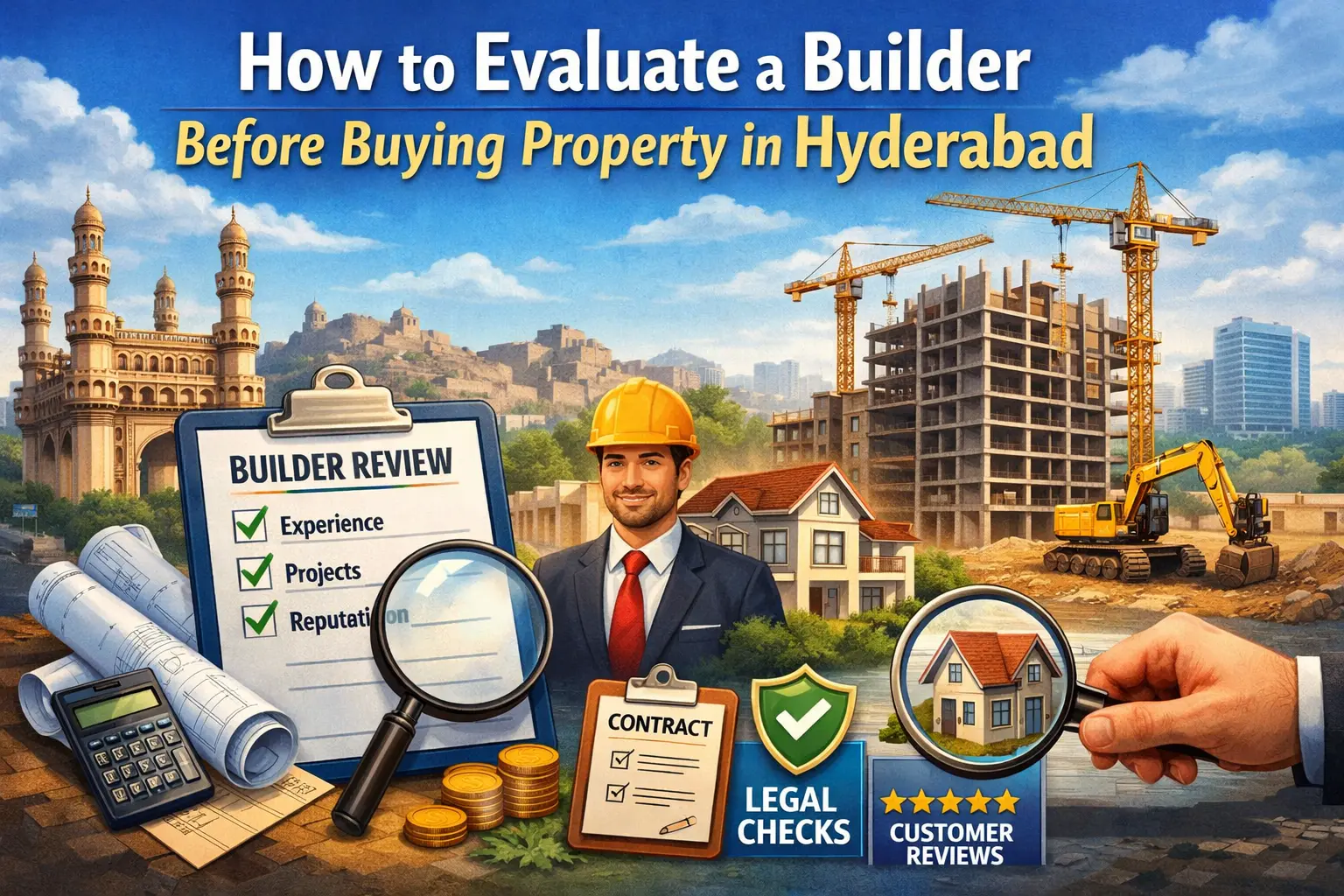
Learn how to evaluate a builder before buying property in Hyderabad. Check RERA, HMDA approvals, track record, legal title, and construction quality before you invest.
Hyderabad’s real estate market has grown rapidly over the last decade, attracting both end‑users and investors looking for apartments, villas, and plots across HMDA limits and beyond. Along with reputed developers, this growth has also brought fly‑by‑night builders, legally weak layouts, and delayed projects, which makes evaluating the builder as important as evaluating the location or floor plan. A structured, Hyderabad‑specific checklist helps homebuyers reduce risk and choose a reliable developer.
Why Builder Evaluation Matters in Hyderabad
Under the Real Estate (Regulation and Development) Act, 2016 (RERA), states like Telangana have created regulatory authorities to bring transparency, enforce disclosures, and protect homebuyers. Telangana RERA (TSRERA) mandates registration of qualifying projects and agents before they can be advertised, marketed, or sold, which means a compliant builder operates under constant regulatory oversight. However, RERA does not replace buyer due diligence; issues like land title, construction quality, water security, and long‑term maintenance still depend heavily on the builder’s ethics and execution record.
Step 1: Verify RERA Registration on TS-RERA Portal
The first non‑negotiable check is whether the project is registered with Telangana RERA. Under the law, eligible projects must obtain a RERA registration number before any marketing, advertisement, or sale of units, and this number must appear on brochures, hoardings, and digital ads. Registration ensures that the developer has uploaded sanctioned plans, timelines, carpet area details, project specifications, and proforma legal documents to the TS‑RERA portal.
Buyers should always:
- Ask for the project’s TS‑RERA registration number and verify it directly on the official portal using the project or promoter name.
- Cross‑check that the sanctioned plan, carpet area, possession date, and amenities on the portal match what the sales team is promising.
- Confirm that the builder has disclosed previous projects and any ongoing obligations, as required during RERA registration.
Any mismatch between marketing material and TS‑RERA records is a serious red flag and may indicate unauthorized plan changes or misleading communication.
Step 2: Check HMDA / GHMC Approvals and Online Status
Within Hyderabad Metropolitan Development Authority (HMDA) limits, builders must obtain development permissions and building approvals through systems such as DPMS and the state’s TG‑bPASS platform. HMDA approval confirms that the layout or building complies with zoning regulations, road widths, land‑use norms, environmental conditions, and technical clearances like structural designs and fire safety NOCs.
Homebuyers can independently verify approval status:
- For layouts and older projects, use HMDA’s DPMS public search to view permit number, project name, applicant, approval date, and conditions.
- Confirm that the survey numbers, location, and project name shown in HMDA records match the documents given by the builder.
- Check whether any mandatory NOCs (airport, fire services, environmental clearance, NALA conversion for agricultural land) are mentioned in the approval file or related documentation.
Buying in unapproved or only panchayat‑approved layouts, especially on the outskirts, has been repeatedly flagged by local experts and consumer forums as a major risk for future violations and regularization penalties.
Step 3: Assess Builder’s Track Record in Hyderabad
A builder’s past performance in Hyderabad is one of the best predictors of how they will execute future projects. Reputed developers typically have a portfolio of completed communities where buyers can physically assess quality, maintenance, and adherence to commitments.
Key aspects to evaluate include:
- Number of years in operation and total projects launched versus actually delivered.
- Timeliness of possession in earlier projects and how the builder handled delays or compensation.
- Construction quality indicators such as seepage, plaster cracks, tiling finish, and lift reliability in occupied communities.
- Responsiveness of the builder to post‑handover issues and warranty claims, based on discussions with existing residents.
Site visits, conversations with resident welfare associations, and independent online research often reveal more than glossy brochures or sample flats.
Step 4: Review Legal Title and Land‑Related Risks
Even with RERA and HMDA approvals, homebuyers should not skip independent legal due diligence on land and documentation. Telangana guidelines for RERA registration require promoters to upload proof of lawful title or registered development rights, encumbrance certificates, development agreements, and sanctioned plans, but errors or disputes may still exist.
Common legal checks include:
- Examining the full chain of title documents and link deeds to ensure uninterrupted ownership and absence of undisclosed rights.
- Verifying NALA conversion (from agricultural to non‑agricultural use) and compliance with master plans or notified land use.
- Checking for lake buffers, storm‑water drains (nalas), and high‑tension lines using HMDA maps, revenue records, and satellite imagery, because construction in buffer zones has led to demolitions in multiple Indian cities.
- Ensuring there are no pending litigations or government acquisition notifications on the survey numbers.
Engaging an independent property lawyer to vet documents is strongly recommended instead of relying solely on the builder’s empanelled advocate.
Step 5: Evaluate Financial Transparency and Payment Structure
TS‑RERA norms require builders to maintain a dedicated project bank account and restrict diversion of funds, which helps reduce abandonment risk. At the buyer level, transparent costing and a construction‑linked payment schedule reflect a professional, well‑planned builder.
Before signing, buyers should:
- Demand a written breakup of base price, floor‑rise charges, parking cost, clubhouse charges, corpus fund, maintenance advance, GST, and registration expenses to avoid hidden add‑ons later.
- Prefer construction‑linked plans over aggressive front‑loaded payment demands, especially for early‑stage under‑construction projects.
- Confirm that any pre‑EMI or subvention schemes comply with current RBI and housing finance norms, and that they are clearly reflected in tripartite agreements.
Lack of clarity or reluctance to share a detailed cost sheet is often a sign of a financially stressed or opaque developer.
Step 6: Inspect Construction Quality and On‑Ground Execution
No amount of paperwork can substitute for physically checking what is being built on site. RERA makes it easier to compare promised specifications with actual work, but quality of materials, workmanship, and supervision still vary widely between builders.
During site visits, buyers can:
- Observe the quality of brickwork, plastering, tiling, window frames, and common‑area finishes in completed towers or sample flats.
- Check fire‑safety provisions like fire exits, staircases, sprinklers, and refuge areas, which are mandatory for high‑rise towers under local building codes.
- Assess practical aspects such as flat‑to‑lift ratio, corridor width, natural light and cross‑ventilation, and noise from generators or STP.
- Enquire about water sources projects with municipal water connections are generally more reliable than those dependent solely on borewells and tankers, a frequent concern on Hyderabad’s outskirts.
Repeated visits at different stages of construction also help buyers monitor progress versus promised timelines.
Step 7: Study Online Reviews, Complaints, and Dispute History
Digital footprints offer another layer of insight into builder reliability. Real‑estate blogs, Google reviews, social‑media discussions, and consumer forums often highlight recurring issues such as delayed handovers, deviation from sanctioned plans, or poor after‑sales service.
In addition, TS‑RERA maintains records of registered projects, orders, and in many cases, complaints and decisions. Repeated adverse orders or penalties against a particular group of companies can signal systemic problems in governance or execution. While occasional negative feedback is normal for large developers, consistent patterns across multiple projects warrant caution.
Step 8: Scrutinize Agreements and RERA-Compliant Documents
One of the key benefits of RERA is standardization of documentation, including allotment letters, agreements for sale, and conveyance deeds, all of which must follow prescribed formats and be uploaded for registered projects. Telangana RERA guidelines require promoters to share sanctioned plans, project schedules, carpet area statements, and draft agreements, enabling buyers to read terms before committing.
Important clauses to review with a lawyer include:
- Definition of carpet area (the net usable floor area sold under RERA) and how it relates to the quoted price.
- Compensation terms for construction delays, changes in layout or specifications, and defect‑liability coverage after possession.
- Conditions for cancellation, transfer, and refund, including timelines and deductions.
- Handover of common areas, clubhouses, and amenities to the association, which can affect long‑term control and maintenance costs.
If the agreement clauses deviate significantly from RERA norms or are left blank at the time of booking, buyers should insist on corrections before paying substantial amounts.
Practical Red Flags to Watch For
Homebuyers in Hyderabad commonly report certain warning signs when dealing with weaker builders. Some of these include:
- No TS‑RERA number on advertisements despite the project falling within RERA thresholds.
- Only gram‑panchayat approvals for large apartment projects within or near HMDA limits.
- Frequent changes in layout, tower positioning, or unit sizes without updated approvals or RERA amendments.
- Over‑aggressive pre‑launch discounts before obtaining sanctions, often marketed purely on landowner‑builder MoUs.
- Poor transparency about land ownership, with vague references to “family‑owned land” but no clear title documents.
Treating these as early warnings can save buyers from long legal battles or incomplete projects.
Simple Checklist for Homebuyers in Hyderabad
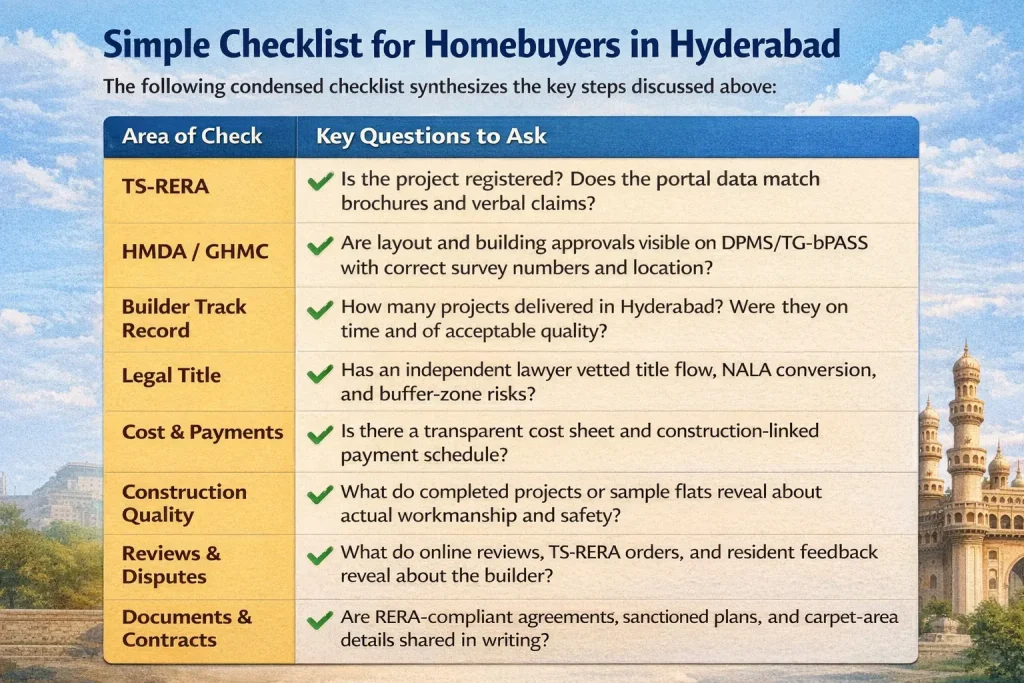
The following condensed checklist synthesizes the key steps discussed above:
| Area of Check | Key Questions to Ask |
| TS‑RERA | Is the project registered? Does the portal data match brochures and verbal claims? |
| HMDA / GHMC | Are layout and building approvals visible on DPMS/TG‑bPASS with correct survey numbers and location? |
| Builder Track Record | How many projects delivered in Hyderabad? Were they on time and of acceptable quality? |
| Legal Title | Has an independent lawyer vetted title flow, NALA conversion, and buffer‑zone risks? |
| Cost & Payments | Is there a transparent cost sheet and construction‑linked payment schedule? |
| Construction Quality | What do completed projects or sample flats reveal about actual workmanship and safety? |
| Reviews & Disputes | What do online reviews, TS‑RERA orders, and resident feedback reveal about the builder? |
| Documents & Contracts | Are RERA‑compliant agreements, sanctioned plans, and carpet‑area details shared in writing? |
Using this table as a personal checklist during site visits, document collection, and online research can bring structure to the buying journey and reduce emotional bias.
Conclusion
Evaluating a builder before buying property in Hyderabad is a multi‑layered process that combines regulatory verification, legal due diligence, on‑ground quality checks, and reputation analysis. Telangana’s RERA framework, HMDA approval systems, and online transparency tools have made it much easier for buyers to cross‑verify what developers claim, but these tools are effective only when buyers actively use them.
By systematically checking RERA registration, HMDA approvals, track record, legal title, financial transparency, construction quality, and dispute history, homebuyers can significantly reduce risk and choose builders who are more likely to deliver safe, compliant, and liveable homes in the long run.